Categories
Training

THE YO-YO EFFECT

The Yo-Yo Effect

The number of athletes that hit hibernation mode in the colder months, especially after their goal races are quite large in number. So to are the volume and type of calories which they consume on a daily basis. This of course leads to a big wake up call when spring suddenly appears. I get to hear lots of “I need to shed so many kilograms of weight and get into shape”.

The problem is that coming out of winter a fair amount over weight actually means that getting back to fitness is a lot further off than you imagined. These are the kind of athletes that use exercise as a means to try to lose weight. I actually find it quite amusing because on one hand training at a much heavier weight places unnecessary strain on the body and of course in their minds they still thinking about paces they ran or rode while at a much lower weight. Also you cannot focus on losing weight and hope to perform simultaneously. Performance happens at an optimal weight and one cannot focus on quality and expect results when they dragging a ball and chain behind them. This will only lead to injury or illness and even more setbacks.

There is no excuse for anyone who spent many months getting into shape just to let themselves go and then battle back up again. It is all about consistency and of course proper nutrition. 

When it comes down to proper sports nutrition food consumption needs to fall in line with volume and intensity of exercise. If exercise is reduced significantly then the calorie requirements need to drop down and fall in line. If you are not training then I am sorry to say you are not an athlete and you will need to eat according to sedentary individual nutrition guidelines. 

Get back into shape with Proper Nutrition 
Lets forget about what you should have done through the toned down training months. Now is that time of the year that you need to get back into shape and training is not the main focus to get back to shape and health. Its proper nutrition. 

The aim of this blog is to get you back on track and hopefully to good fitness and health without placing yourself at risk for injury and illness. 

When it comes to working with any athlete I first calculate what is called the rest metabolic or basal rate. They are different in how they are calculated but each is unique to an individual based on age, weight and of course the kind of body composition and metabolism. Although there are standard calculations, some people have slower or faster metabolism’s than others and this needs to be taken into account. 

 
The RMR or BMR (Rest Metabolic or Basal Metabolic Rate ) of an individual will help me determine the approximate amount of calories that an athlete burns off on an average rest day. Once I understand this I then add in the weekly training and determine a physical activity level for that individual based on time and intensity. This will allow me to understand the type of calorie burn rate that an individual goes through during the week. When it boils down to sports nutrition each day is a different day and while some dietitians focus on an average daily intake for the week I disagree with this approach.
 
Take the shaped nutrition approach 
I suggest focusing on a shaped nutrition approach where the volume and type of macro-nutrient intake revolves around your training. The reason its preferable is that each day our training differs. As an endurance athlete I can have a rest day or even two in a week and some weeks are completely loaded with heavy volumes and even more so on the weekends. Quality sessions also demand more from our body’s. This means on some days my calorie burn rate is very high and on some days its down pretty low.


The issue with just an average calorie deficit program is that if the dietitians are not themselves endurance athletes and not experiencing these major demands on the body from day to day and week to week then how can they understand what we go through. Its not just theoretical it has to be practical. If I have power numbers and paces to hit, I need proper fuelling and recovery. If strength is added in I need to again look at what I am consuming especially in the form of protein o help with recovery and training adaptations. It is not a constant number.
 
When talking about actual fuelling the human body has two major fuel tanks glycogen and fat. Some days, exercise dependant, I chew up more glycogen and some days are higher fat burn session days. This also determines the kind of fuel I should be consuming to ensure proper recovery between sessions. On days where I deplete glycogen stores a higher carbohydrate intake is required to help replenish them quickly to ensure I recover properly for the next session. On days where my glycogen stores are untouched I can afford to lower my carb intake. This is a form of carbohydrate cycling and works very well for endurance athletes who need to push decent numbers and ensure they recover quickly and properly between sessions. 
 
 
Weight Loss and Power Maintenance
Lets talk about weight loss (specifically fat loss) and power maintenance. This is where the problems could be seen. Generally we see most dietary guidelines placing an individual in approximately a 500Kcal deficit to pull down the weight. I agree with the larger calorie deficit approach to weight loss however its not advisable during peak volume and hard training bouts.  It’s also not just about the deficit its also very much about portioning each meal correctly to ensure that when you are training you actually able to also maximise elevated metabolic rate and fat burn through each day.

A few weeks ago I was standing at the Kauai in the gym next to a guy who was ordering a large smoothie. This particular smoothie was around 600Kcals. I asked him what training he did and he said he had done a 40 minute jog on the treadmill. Taking this session into account and the fact that he only burned off around max 400Kcals his recovery meal was already in excess of what he had burned off. I chatted to another athlete who ordered a healthy wrap but this wrap had a calorie content of of over 800Kcals and here we go again with a burn rate way lower than what the consumed after his session. Many people don’t realise that even if food is perceived as healthy it still means you can over eat the health. 

With the above in mind I am not going to stop you from ordering your favourite health food but what I am going to do is make a suggestion so you can ensure you burn the fat and drop the weight. When it comes to body fat gain its all related to blood sugar, insulin and fat storage. If you can manage your blood sugar properly and keep your metabolic rate elevated you can absolutely burn a lot of fat through the day. The idea is to train, elevate the metabolic rate ( high intensity intervals work best) and then limit anything that will cause a major rise in blood sugar. This comes down to portion control because even a large piece of meat can elevate blood sugar due to its glycemic load when it breaks down.

How to still enjoy your Favourite Meal
One such way for example is to order your favourite smoothie. Just make sure you have the correct amount of protein in there to count towards getting your daily needs. Drink only half the smoothie post exercise and then an hour to ninety minutes later have the other half. If you go for a large calorie wrap then get it cut into quarters or thirds and split that meal over the day spaced nicely apart so as not to play havoc with your blood sugar and give yourself a fighting chance at burning that fat.
 
One thing I want to add is that if you are in peak racing season you cannot expect to be pushing out major mileage, power and pace numbers and expect to achieve your goals and recover properly with a large calorie deficit. In this case we narrow the deficit to ensure we can perform properly without fatiguing. 

I will touch on macro nutrient recommendations in another blog but for now take note of where your focus should be. Don’y play Yo-Yo with your training and nutrition, keep it healthy keep it controlled and make sure to burn that fat.

all the best

M

Mark Wolff is a certified exercise & sports nutritionist, endurance nutrition and physiology expert with over 20 years experience. An endurance multi-sport athlete with a running, triathlon, mountain biking and weight lifting background, he works extensively with professional and amateur athletes in a variety of sports disciplines as well as those just wanting to change their lifestyles. He firmly believes that a person can only reach their full potential when their health and nutrition is given the proper focus. Mark’s focus on nutrition and physiology is not just on training and racing, but he places major emphasis on recovery, immune system health, emotional stability, stress management and performance. Mark is co-founder of 32Gi, a sports nutrition company, focused mainly on health and endurance nutrition. He is also co-founder of Rapid Recover focused on pneumatic compression equipment to improve circulation for recovery and health


Categories
Training

CRUSHED INTO HUMILITY – A LESSON LEARNED

I am just going to start this blog but saying that sometimes in life no matter how knowledgeable you are there are sometimes no lessons valuable or hard enough than those lessons learned by personal experience.

This last weekend was a lesson that gave me not just the knowledge to be able to help others but it completely schooled me in a lesson I will never ever forget.

So  here goes my story……………

The past few weeks I have been managing to put in some really decent mileage into my training with some nice volume sessions on the bike. Two weeks ago I had a stellar 165km ride (data posted below) but this past weekend over a similar distance and conditions I landed up in an absolute sufferfest of a session. Over the past twenty years no matter how hard I have raced or trained I had never felt like this in my entire life. I was thinking back to some of the most excruciating races I had done and in actual fact nothing came vaguely close to what I experienced on last weekends ride.

Lets take a step back and I will explain everything in detail to set the tone.
Five of us headed out on what was structured to be a five and a half hour session. The guys I am riding with are all doing Ironman in a few months and the volume weeks are in full swing. It was breezy but not overly so and the temperatures at our 6am departure were mild but expected to climb fairly high later in the day. I was feeling really good when I woke up. Had a perfect pre-training meal and off to meet the guys for the start. My first four hours on the bike were solid I was sitting at around a 34-35km/h average speed. We do not ride in bunches we go solo its the proper way to train for a triathlon. Just over four hours into my ride my right adductor suddenly tightened and then eased up. It was a strange feeling it had never happened to me before. I realised it was hot and I decided top up my water bottle at a shop on route. While doing so the other guys had passed me and I was just going to play catch-up and try to ride back to them. I climbed on my bike and started a gradual incline to head back towards the home stretch. In the distance I could see one of the cyclists but I was not feeling great at all. It was a kind of ill feeling and I just hung in there and spun the pedals. As I crested the climb I noticed they were stopped on the side of the road as one of the cyclists had punctured and they were helping with the repair. I stopped and waited but at that stage a wave of nausea and fatigue came over me. I was thinking this is absolutely not normal. Johnny one of my one training partners asked if I was OK and I was like “No, I feel terrible but we nearly home and I will just spin it out”.

We carried on and unfortunately where we live and train absolutely nothing is flat and there is always a wind and on this day the direction was not overly kind. We reached an area which started to descend and gave me some respite but as we started the ascent on the other side both my adductor’s suddenly locked. I was in absolute pain. The last time I ever cramped was in 2003 (I remember that race clearly and knew what caused it) but absolutely nothing since.

I stood out of saddle trying every stretch possible and nothing. I had half a bottle of 32Gi hydrate left and downed it quickly. I realised at that point that only some mineral loading might help and within minutes of consuming the bottle the cramping eased but my concern was for how long? I carried on riding and when I hit the next climb the cramps hit me again but this time even worse. The situation was really not good, nausea, fatigue and now the cramps. I did not want to stop yet and I knew there was a petrol station down the road so I spun it out and when I got there I decided to down a high sodium drink again trying to settle the legs a little. It seemed to work and I carried on. It was plain sailing now with the wind behind for seven kilometres before we hit the last nasty seven kilometre climb back to the Virgin Active gym where my car was parked.

As we hit the climb back towards home my legs started again and I was feeling worse by the minute. I was hanging on by a thread and eventually with 2km’s to go I just stopped on the side of the road.

Johnny said “and now?” I said “I have had enough friend I am in a world of pain and I am going to Uber back”
He looked at me and said its just 2km’s back. I was  thinking those 2km’s are going to be the death of me, but I will spin it out. I got back to the gym, my average speed had dropped down significantly in the last half an hour which was a true reflection of the agony I was going through. I got off my bike and collapsed into the boot of my car and lay there for a while. I could not move and anyone that tried to come and talk to me at that moment in time I hated and wanted nothing to do with the world.

I eventually managed to get into the gym and ordered two ice cold bottles of water from the Kauai. I threw some 32Gi hydrate into each and started to down them. I made my way to the change room to shower and I sat down there for around 15 minutes before I could even move to the shower. Eventually I managed to shower but was still feeling really ill and when I came back to change it took another 15-20 minutes to get dressed as my legs were locking so badly. I could not even get my socks and shoes on.
I was thinking that this was quite a turn of events as the week before over a similar ride distance and effort I was bouncing out the gym my legs were so fresh the next day that I hammered them in a strength session. On this day however I felt like I needed to be carried out.

What went wrong?
I just could not understand. I knew I was severely dehydrated but why? I have trained in some of the hottest climates in the world and I am so acclimatized to exercising in the heat and never ever had an issue. Something went wrong and I needed to find out what. I went to the scale to weigh myself. The scale revealed the truth as to how dehydrated I was. I had consumed over 5 litres of fluid and my body weight was still 2.7kg down and my current weight is 63kg’s. Now you can do the maths that was a huge deficit. I had succumbed to severe dehydration. This weigh in was after consuming some post session fluid. That means that I probably hit around 6-7% during the session maybe worse. But why?

I then looked at my session data. My speed had dropped from an average of 34.5km/h to 31.3km/h in the last forty minutes. I definitely crashed and burned. My average speed last week on my 165km ride was similar to this week and my average heart rate was around 129BPM for the entire session. When I looked at my heart rate data for this session I was shocked. My average for the entire 5.5hrs was 156BPM. Now for some it might not sound high but for me its very high as it sits at over 85% of my MHR. This was not normal and something had happened.

Below are some graphs of previous weeks ride similar route and effort (the week before the wind was incredibly tough head wind so speeds were slightly down, but overall effort was consistent) the left column is the previous ride while the right column is my personal sufferfest.

I traced my steps backwards and then suddenly it dawned on me. The night before I was lying in bed and I started to feel a post nasal drip which was burning and aggravating so I decided to take a decongestant to prevent the onset of illness. I have used this decongestant before and to be honest its been useful when needed. Generally though when used in the past it has been around 24hrs out from shorter sessions however this time it was around 9hrs out from a long session.

When I woke up I was feeling great and my sinuses were nice and clear no aggravation. The problem is that most decongestants especially this one are vasoconstrictors. This means that the blood vessels are narrowed due to contraction of muscle walls of the vessels especially large arteries and small arterioles.  This is how they work by constricting the vessels in the nasal passages. I usually stay away from medication completely but I have a type of re-occurring illness from a virus I contracted in 1999 and it triggers in the sinus tracts so this was my way of preventing it. The problem is the half life of this vasoconstrictor seemed to hit my training session and when the vessels are narrowed it also means that the body’s natural cooling mechanism wont function properly.

In order for cooling to happen during exercise our body’s are designed to promote heat dissipation by sweat evaporation through increased skin blood vessels. This is a process called vasodilation and this occurs when exposed to heat. But in my case I had taken something which constricted the vessels causing my body to heat up extensively without realising it. This of course severely elevated my heart rate and started a large chain of events. No matter how much fluid I took in there is a limit as to how much the human body can absorb (for more on hydration check out my blog Simply Hydrate). I had triggered a domino effect which spiralled out of control as my lengthy session continued.

A few hours after this experience I finally managed to stabilize myself by consuming 32Gi Hydrate (click here for more on 32Gi Hydrate) and I felt a lot better. However unbeknown to me this was not going to be the end of my woes.

Fast forward to the early hours of Wednesday morning when I woke up due to some dull aching lower back pain. Predominantly on the left side of the body. I lay there thinking very carefully about it as I am quite in tune with my body and this was not a typical lower back ache. I eventually pinpointed it and suddenly realized what was happening. It was kidney pain. My diagnosis immediately turned to worry. It was roughly three days since my bad experience and that was either bad coincidence or the onset of what could be rhabdomyolisis. Usually rhabdo is triggered by muscle damage or breakdown, which could have been triggered in my case of being severely overheated and dehydrated on my Saturday ride. The problem is this does put stress on the kidneys and in some cases renal failure can occur and that is life threatening and not something you want to be thinking about in the early hours of the morning.

I got out of bed ran to the fridge and began consuming water with bicarb to start a process of helping the kidneys function and trying to take the stress off them. I did not know what the story was and had to wait until morning to visit the physician to have bloods run urgently.  I got the first appointment that morning and immediately had the blood tests done. All I could do now was wait and keep with my bicarb hydration regime.

Eventually the bloods came back and everything I suspected fell into place. I had very elevated creatine kinase levels, chloride levels were low and bicarb higher (due to my bicarb drinking)  and creatinine levels were quite a bit down with kidney function normal. (bloods below)


I wish I actually had a blood sample from immediately post session as that would have shown a lot. The blood works clearly showed that I had undergone some very strenuous session on the weekend. The fact that I hadn’t really trained since then and the fact my creatine kinase levels were so elevated 4 days after was a definite sign of severe stress. However I was very happy to see that the kidney function was absolutely fine as that was my major concern.

An interesting discussion with the sports physician left us asking a number of questions. If vasoconstriction was in full force where was the dehydration taking place? Where was the fluid leaving the body. Was it a much higher sweat rate later on in the session when I was fully over heated, and the effects of the medication had worn off? I did have a pit stop on route but the day was a blur if you ask me how much fluid left me during a pit stop I could never say. I did consider hyponatremia as possible high fluid consumption due to the body heating factor to keep cool but once I analysed my intake during the session I realised that it was not really an option, but could the stress on the body have hampered fluid absorption? The key indicator was how I felt and my weight post exercise showed definite severe fluid loss.

To conclude this blog of my painful lesson learned I want to say a number of things.

Firstly the human body is a complicated yet incredible landscape of brilliant engineering which will always look to find balance to keep us healthy and alive.
It has the ability to operate under a wide range of conditions by taking care of itself in different ways. If you think that ingesting something so small will not upset the balance and rock the boat you are clearly mistaken. Our bodies are quick to react to anything that is placed in it and the consequences of our actions can be of either benefit or detriment. In this case it was the latter.

Secondly I need to state that I am completely against NSAID’s (non-steroidal anti-inflammatory’s) during exercise due to the severe life threatening conditions that something like that can trigger when the body is under stress. It is like loading a revolver and playing Russian roulette. You can get away with it a lot but then one day the bullet can exit the chamber and by then it is too late. In my case being knowledgeable and having first hand experience working with athletes over many years of whom some I have known to have suffered renal failure and even kidney loss, it was quite an eye opener.

I have always taken the utmost care to make sure that the timing of any medicinal intake and stress over the body do not coincide. However being one that avoids medication at all costs and maybe being more sensitive to it, landed me up in some deep water on this one day. The interesting thing is that in a shorter session even up to 4 hours nothing major happened it was only the last hour where the havoc began. This demonstrates quite clearly the pitfalls of hydration and sports nutrition over longer periods of time. It also demonstrates to the endurance community that no supplement or medicinal drug should ever be taken lightly. I have always stated the fact that an athletes body is finely tuned and tiny things can truly upset the balance as was shown in my case.

I wrote this blog on my personal yet valuable experience, as a message to others out there. Make sure you understand that whatever you place in your body in one way or another will have an outcome. Understand exactly what the potential risks are for anything you consume and avoid anything that you know could potentially have a dangerous outcome.

all the best

M


Mark Wolff is a certified exercise & sports nutritionist, endurance nutrition and physiology expert with over 20 years experience. An endurance multi-sport athlete with a running, triathlon, mountain biking and weight lifting background, he works extensively with professional and amateur athletes in a variety of sports disciplines as well as those just wanting to change their lifestyles. He firmly believes that a person can only reach their full potential when their health and nutrition is given the proper focus. Mark’s focus on nutrition and physiology is not just on training and racing, but he places major emphasis on recovery, immune system health, emotional stability, stress management and performance. Mark is co-founder of 32Gi, a sports nutrition company, focused mainly on health and endurance nutrition. He is also co-founder of Rapid Recover focussed on pneumatic compression equipment to improve circulation for recovery and health.


Categories
Training

DON’T BLAME THE WEATHER, BLAME YOURSELF

Excuses, most of us hear them all the time. This past week I heard a barrage of them for why a race or a training session was not finished. The common denominator it was too hot was what I was hearing constantly.  There is very often a lot of blame on weather conditions when it comes to personal failures in endurance sport and to be completely blunt you should not blame the weather you need to blame yourself.

It is called lack of preparation and failure to understand what the body requires when the temperatures are soaring. When you decide to participate in any event you need to have in mind that you have no control over the weather conditions. The only control you have is over your body and how to help it cope under all conditions. The problem with most athletes is they train and train, but mostly they neglect the most important elements of proper sports nutrition being hydration and fuelling under various conditions. So early mornings of training under usually mild to pleasant temperatures suddenly leave them grasping at straws when placed into an event under severely hot conditions because they have absolutely no idea how to cope with it. Fuelling and hydration strategies are so crucial to any type of training or racing session to empower performance and lower the health risks associated with conditions such as hyponatremia, severe dehydration or heat exhaustion.

In the 2014 Comrades Marathon, I was on route in a follow vehicle feeding the elite athletes we worked with. In that year with about 30km to go there was a small break of around eight great ultra runners. Eventually Bongmusa Mthembu ran off the front and for the next 25km’s he became our focus. The weather conditions at the time were very hot and humid and after running 65km’s you can only imagine what the body is going through. His pace through those last 25km’s was stellar it was incredible to watch him running so strong. The interesting part was that we fed him around 30 water sachets over that last part of the course of which he probably only drank 2 of them and the balance he threw over his head and core area. Bongmusa new exactly what he was doing, he was trying to cool his core temperature from the outside to try to keep his heart rate down to allow him to perform at his best. We know with heat comes elevated heart rate and perceived effort. The way he managed it was totally professional and showed his experience. Bongmusa went on to win comfortably and it was a pure demonstration of the understanding of his personal requirements of nutrition and hydration to be able to perform at his best.

In 2016 I was invited to participate in a tough multi-stage trail race in Israel. The trail run was a 204km course over around 18 to 19 hours. Our race was destined to start at 1:30PM in the month of September when the temperatures were still very much reaching peak summer highs. I had six weeks of preparation ahead of me and due to the very nature of the course and race structure I put a plan of action into place. This consisted of later morning training sessions to acclimatize to the heat as well as doing the occasional triple training sessions a day being morning, noon and night. I needed to ensure that my body would be able to cope over the various temperatures the race had to offer as well as experiment with my hydration and fuelling strategies to ensure I could perform at my best.

The point I am trying to get to with the examples above is that when you prepare you prepare properly and that includes the hydration and fuelling strategies along with the training otherwise you will set yourself up for failure. So often I see cycling groups being broken down to non-pitchers purely because it was too windy, too cold, too hot. If you don’t experience these conditions how can you expect to race in them. You have no control over the weather you only have control over your conditioning, experiences and fuelling.

So in short my advice to you all is train as you will race. If it is a course with loads of climbing then embrace the mountainous training routes. Understand how the body will perform in wind, heat and cold. Make sure you understand your hydration and nutrition requirements because it will differ under various conditions. Always separate out your nutrition and hydration requirements and make sure the formula you put together works for both.

More fluid loss in the heat means understanding your hydration requirements perfectly and water alone will not be sufficient due to minimal absorption rates and the introduction of minerals, isotonic or hypotonic mixes might be required. Check out my previous blog Simply Hydrate for more in-depth information on hydration. On the fuelling side of things understand your energy requirements and make sure you nail it. I did a previous blog touching on training and race fuelling called Fortuitous Fuelling just click on the link for a deep dive.

The next time you are planning a training or racing session make sure you cover all your bases. Work the racing terrain in training and understanding exactly what will work for your body from a hydration and energy perspective under any varying weather conditions. As the great Benjamin Franklin once said “By failing to prepare you are preparing to fail”

all the best

M

Mark Wolff is a certified exercise & sports nutritionist, endurance nutrition and physiology expert with over 20 years experience. An endurance multi-sport athlete with a running, triathlon, mountain biking and weight lifting background, he works extensively with professional and amateur athletes in a variety of sports disciplines as well as those just wanting to change their lifestyles. He firmly believes that a person can only reach their full potential when their health and nutrition is given the proper focus. Mark’s focus on nutrition and physiology is not just on training and racing, but he places major emphasis on recovery, immune system health, emotional stability, stress management and performance. Mark is co-founder of 32Gi, a sports nutrition company, focused mainly on health and endurance nutrition. He is also co-founder of Rapid Recover focussed on pneumatic compression equipment to improve circulation for recovery and health.


Categories
Health Performance Training

“RACE FOR VICTORY”

Throwback to 2013 the Yarkon 25km trail race.
Nerves through the roof not so much due to the race but more for the last year of a severe illness. You see in 2000 I contracted a water-borne virus from my daughter which left me bed ridden for quite a while. The medical specialists that ran a major battery of tests on me over the weeks that followed failed to pinpoint the cause of the problem. All I knew was I was suffering badly and was concerned about my future I had absolutely no hope. I had to make a harsh decision and take complete control which would not just change my life but also my career. Each year I would be hit with another attack by this invader in my body trying to subdue me and take complete control. The roller coaster ride and massive doses of antibiotics and tetracyclines along with many other treatment protocols was just an absolute journey of hell and I realized I was going to be in a life long war with this internal enemy. Becoming a physiology expert and sports nutritionist was not an accident it was a path I chose to win the war and to help others win theirs. After years of fighting I eventually triumphed and landed up with a relatively calm period. However in 2012 the invader had spent years strengthening its forces silently and when it was ready, it unleashed the most lethal attack on me that left me for the better part of 6-7 months virtually bed ridden and barely surviving from day to day. I nearly gave in, but then decided to pull out all the ammunition I had and give this bastard another war it would never forget.

Fast forward to September 2013, I hadn’t raced in a long time, I had been training again and felt stronger. I was invited to attend this race by a friend and I told him I would join, but run at a comfortable pace. I was nervous because all that was on my mind was the war I had just been in and the fact that after all I had been through, was this race going to be the trigger to knock me back down, would I even finish it. I withdrew from it a thousand times in my head. On the day I didn’t know how I felt. It had been so long since I actually felt normal.

A short warm up run and then off to the start line with all the other hundreds of runners. My heart and mind were in a mode of not knowing what to expect and I had to keep reminding myself this was just a training run. Take it easy, pace yourself and get through it.

It was a very hot time of the year and the race began very early in the dark of the morning to avoid the heat as much as possible. Waiting there suddenly the gun went off.

I have absolutely no idea what went through my mind but I switched to a completely different mode. I just saw a group of three guys running off and I ran after them. Everything I felt fear and anxiety for, just switched off and I chased them down. They were around a hundred meters ahead and we were now full on the trail with not much space either side. Suddenly my watch vibrates, 4:04 pace it shows and I am thinking what the hell are you doing Mark? You said you would run a comfortable pace and this is kilometre one. I just ignored it and ran after the group and at the 2nd kilometre I was just behind them. My watch buzzed again and this time a 3:56 split. I was feeling surprisingly stable and my competitive nature just completely overpowered my body and I ran up to the group.

There were two runners in the front and myself and another guy behind all running in unison over the dry sandy river bed beneath. In the corner of my eye I noticed the runner behind with me was wearing a cycling vest with open pockets to carry his race fuel. It was then I realised this guy was not a “true runner” and I had this feeling he was going to struggle soon. Maybe that was the arrogant part of me but I am very strategic when it comes to training and racing and this was my gut feeling. My Garmin vibrates for the the third split and now we are at 3:51 pace. I was settling in slowly. The terrain was not easy, lots of loose sand but I had chosen a very light weight race shoe instead of a full blown heavy trail shoe to help with the foot lift in the aim of skipping over the really soft sandy areas on the track.

The sun began to rise and as we started to approach kilometre five I heard sudden breathing changes in the athlete next to me. I knew this meant he was done for it was just a matter of when. Over the next kilometre I could sense the struggle in him as he was dropping off and trying to run back. He was burning big matches and he eventually fell off the back permanently. It was game over for him.

The problem I was faced with now was that there were three of us. Yes, 1,2,3 all podium positions and when you are in a situation like that you never want to let it go. The race was an out and back to make up the 25km. I began to strategize and decided to try to hang on as long as possible with these youngsters, especially to the turn around point, as then I could see the gap behind us as we headed back towards the onslaught of the pursuing  runners.

At the 10km mark we still hit 3:50 splits and I was thinking this is super fast for a trail. Although fairly flat and not overly technical the legs had to work hard over the different planes due to the differentiating and uneven surfaces. We started nearing the turn around point and I was still feeling good except when we hit the feeding table at the 11km mark the volunteers had not set up yet. They didn’t realise we would get to them so quickly  and that made me very angry as I had just missed a crucial feed and hydration point. So I would have to try hit them again on the way back and hope I could hang on. Then it came, the turn around point, the three of us soldiering on and I started the gap timing. I wanted to see who was hunting us and how far behind they were. Eventually it came the first hunter was around 4 minutes behind us with around +-11km to go. I did a quick calculation in my head based on time and distance and realised that even if he was a Kenyan marathon runner he was not going to catch us.

All I had to do now was hang on and not crash and burn. As our trio kept on we eventually realised that the race was now between us and new tactics were going to start playing out soon. At kilometre 21 the race heated up and one of the guys went off the front, number two then followed and as much as I tried to stick with them I was left on my own. They had dropped me and the fight for 1,2 was now not in my hands. With around 2km’s to go I was now feeling the pain, I had not hit a single feed table on route and I could feel my glycogen stores were dwindling to the point of no return. All I could do was dig deep and suffer it out. The thing about being in the hurt zone is that 1 or 2 kilometres don’t sound like much but in actual fact every second is excruciatingly painful once you are there. A kilometre feels like forever. It is a fact that he who can suffer the hardest and longest will win.

Nearing the trail exit I could feel the finish line getting nearer and soon I could see it. All I could think of is getting there so I can start breathing again and allowing the legs to stop working. As I approached the 50 metres to go I had an overwhelming feeling come over me and I completely broke down. Tears followed my final footsteps to the finish line. It wasn’t because I was on the podium, but more due to my victory of the war I had been fighting for so many years. I again had shown the invader I was triumphant over it. I never dreamed this moment would be possible. Lying bedridden down and out leaves you with a sense of hopelessness. However this exact moment in time was the tipping point it was my victory. They always say when you get knocked down just get back up and show them. But sometimes people get knocked down so many times it is a lot easier said than done. On this day I realized that it can be done.

This race was probably the most special I have ever done. It was a moment of survival of victory and one of absolute gratitude for the blessing of being able to have come back to health. Over the years I was invited to return to participate in this race a number of times. I don’t think I ever will. This race always has a special place in my heart it was the pinnacle experience that will need to stay etched inside forever.

In the end I finished 3rd overall, running the 25km trail in 1h42 and finishing just 90 seconds behind the winner.

“Value your health without it there is no hope”

all the best

M

Mark Wolff is a certified exercise & sports nutritionist, endurance nutrition and physiology expert with over 20 years experience. An endurance multi-sport athlete with a running, triathlon, mountain biking and weight lifting background, he works extensively with professional and amateur athletes in a variety of sports disciplines as well as those just wanting to change their lifestyles. He firmly believes that a person can only reach their full potential when their health and nutrition is given the proper focus. Mark’s focus on nutrition and physiology is not just on training and racing, but he places major emphasis on recovery, immune system health, emotional stability, stress management and performance. Mark is co-founder of 32Gi, a sports nutrition company, focused mainly on health and endurance nutrition. He is also co-founder of Rapid Recover focussed on pneumatic compression equipment to improve circulation for recovery and health.


Categories
Health Nutrition Training

BLOODS DON’T LIE

When it comes to endurance sports performance and health we have all been exposed to the endless attempts to find the biggest gains in improving oneself. Most athletes that approach me are looking for an improvement in performance however my biggest concern is first health. I have always said that when we place our bodies under stress its important to make sure that the body can withstand the stress. If there is an underlying condition which the athlete is not aware of the consequences can be damaging if not life threatening.

As an endurance athlete and of course a human being nothing is more paramount than my health. When it comes to the human body the more you know about your own body the far better empowered you are to make the correct decisions when it comes down to it. I am sure most of you have heard about the term biological passport. This is used to monitor elite athletes in which profiles of biological markers of doping and results of doping tests are collated over a period of time. I have my own biological passport. I have 12 years of blood markers ranging from a wide variety of testing over time. However my passport is a biological health passport not a doping passport. I use this as a baseline for a range of different markers to ensure my body is in optimal condition to be placed under stress and to be able to perform at its peak when it comes down to it. As a sports nutritionist and physiology expert there is nothing more satisfying than getting blood results finding the anomalies and then using either treatment, nutrition or supplementation to correct them and get them back into line or even fortify them. However it goes much further than this. A general doctor will look at a range of bloods which are considered to be in the “healthy” range and give you the nod. I don’t do that I look at the bloods from an athlete perspective knowing that the individual is placing the body under a huge amount of stress whether it be an ultra distance marathon or triathlon. “Healthy” ranges are just not always good enough and in endurance sport tiny deficiencies or changes can equate to feeling flat or being able to really put down the hammer down and sustain it. Bloods don’t lie they will tell a story and guide a person in the right direction. Last year an elite athlete that approached me for assistance gave me the title “the legal doper”. I wasn’t sure how to take that as the word doping has many negative connotations associated with it. But on further thought I decided that to be able to legally enhance the human body is definitely the route to go as that has a big focus on health not just performance.

So my question to you all is do you have a snap shot of your health?  By that I mean a full set of bloods and the peace of mind that you are in good working order. Secondly once the doctor tells you that you are in good working order has he or she taken into account your active lifestyle. You are not a couch potato but a Ferrari engine and there is a big difference in requirements especially when it comes down to fuelling. Haematology is a fascinating pathway where hundreds of thousands of different chemical reactions and responses happen each day to what the body is going through. I would want to make sure that what is happening inside is life extending, performance enhancing and not destructive.

I have pulled up some bloods below just to deep dive a little and explain how some dietary and supplemental changes have made a huge difference in not just mine but other athletes lives.

Below shows an endocrinology profile of an athlete where I specifically requested  folate serum, red cell as well as vitamin D. 6 months prior to this test the results were not good. Vitamin D levels were sitting at 32, which by all means is healthy according to the medical spectrum and the folate levels were a lot lower. Vitamin D is actually the one vitamin that is scientifically and medically proven to strengthen the immune system. Its also the precursor to calcium absorption which means if you are an athlete you definitely do not want it to be on the low end at all. A very strong 5000iu D3 supplement pulled it up to 54 from 32 in 6 months and then the dose was dropped down to a D3 every 3 days at which stage the levels climbed further to 60. That is nearly double where it was before.

Noticeable differences in the athlete were not even such as a cold or illness in a two year period whereas prior to this at least 2-3 antibiotic courses a year. In addition there was a drop in shin splint pain until eventually it dissipated completely and never returned. Susceptibility to stress fractures had been reduced however I do need to mention in conjunction with the D3 a good calcium was also prescribed.

Below shows the increase from 54 – 60 at which stage we toned down the Vitamin D supplementation.
Its interesting to note this is an athlete who spends a lot of time outdoors and so the thought of sunshine providing Vit D although somewhat true is not always about exposure but about creation.

Below shows an athletes iron profile. It is in the normal range but again this is a serious athlete putting in many hours of training in a week. The feelings of fatigue that he experienced can sometimes be due to what we call athletes anaemia.  I felt the levels were too low although within the normal range so supplementation was brought into the picture.

Below shows the Iron supplementation over a 3 month period pushing the levels up nicely. I need to mention this athlete is a ovo-vegetarian although levels came up nicely the supplementation continued with a drop down to one tablet every 3 days to keep them topped up. The athlete noticed increased energy, better recovery and performance benefits.

No elite athlete wants to see the below especially when aiming for a top position in a race. Low red cell, low haematocrit is not a desirable result especially knowing that you are limiting your haemoglobin production and this is so crucial for muscle and organ function. The last thing you want is limiting it especially if you are an athlete. You can also see that the iron is low and understanding haematology you should know that red blood cell, haemoglobin and iron are all interlinked.  The below shows low transferrin levels which can relate to iron binding capacity. The athlete did not have sufficient blood in the diet. Taking a look at the individuals lifestyle we discover an over trained athlete under nourished meaning absolutely poor nutrition to support the exercise volume and intensity. Multiple menstrual cycles in a month led to more blood loss than normal and major changes needed to be made to the diet to correct this.  Again Vitamin D levels could come up nicely especially since this was an athlete that suffered from numerous bone related injuries which could be a direct result of nutrient deficiency.

Below is another female athlete with dedicated 6-7 days of training combining 70-100km run weeks with strength training. Waking up daily feeling faint, dizzy and often bouts of nausea until the day she fainted and hit her head on the treadmill. The below shows clearly an iron deficiency as the cause. The inability to feel energetic, wake up fresh and be able to train with a smile on your face is not the way one would want t be feeling each day. Dragging yourself through life from day to day is terrible. It took so many weeks to convince her to get bloods done and with all the delays it set a domino affect into play leaving her to do them out of desperation. Prevention is always better than cure.

The below was sent to me after a blood test by a concerned athlete. After questioning the timing of the blood test the cause was clear that the athlete gave the blood in a completely dehydrated state. It was after a hard long run in the heat, followed by a oats breakfast and cup of coffee. This is an athlete that usually trains fasted and on that particular day he noted he felt very thirsty and battled through the heat. Then went for bloods. Pick your blood test days carefully you don’t want to skew the results.


I can bring up hundreds of blood results over the years where each will tell a different story. Sometimes the biggest percentage gains in sports performance need to actually start with the health aspect and only once that is solid then one can move to the next level which is proper tweaking of nutrition and natural supplementation to gain a little more. There are no quick fixes and most people I come into contact with tell me about all the wonderful and weird supplements they take to give them the edge. They have absolutely no idea what they are talking about because what they could be taking might be doing exactly the opposite and hurting their health. Know your status first then we can talk.

In conclusion, as an active person start your biological health passport, get tested fairly regularly and get an idea of your health status over time. Anomalies might come and go but at least if you have a history of what is going on inside your body you will be in a much better position to manage the risks as well as improve your health and performance goals.


Take care

all the best

M

Mark Wolff is a certified exercise & sports nutritionist, endurance nutrition and physiology expert with over 20 years experience. An endurance multi-sport athlete with a running, triathlon, mountain biking and weight lifting background, he works extensively with professional and amateur athletes in a variety of sports disciplines as well as those just wanting to change their lifestyles. He firmly believes that a person can only reach their full potential when their health and nutrition is given the proper focus. Mark’s focus on nutrition and physiology is not just on training and racing, but he places major emphasis on recovery, immune system health, emotional stability, stress management and performance. Mark is co-founder of 32Gi, a sports nutrition company, focused mainly on health and endurance nutrition. He is also co-founder of Rapid Recover focussed on pneumatic compression equipment to improve circulation for recovery and health.


Categories
Health Training

BURN THAT FAT

While about on my daily routine whether in the gym or outdoors training, at the office working or shopping I have very sharp eyes. Sometimes I feel guilty about the thoughts that roll around in my head, but after all I am there to put a stop to it where I can and assist those that are in need.

Why guilty?

Because as a sports nutritionist I monitor habits. I watch what people buy in grocery stores, I see what they eat in restaurants, how they fuel themselves during and after training sessions and I judge. It’s not their fault they live by emotion, habit and daily stresses. They think they are making the right choices but they just don’t have the knowledge to ensure those choices are healthy and correct. This is where I try to turn the tables a little on the unhealthy fast moving consumer goods industry and attempt to pass on a little knowledge so that they can make better and healthier decisions going forwards.

In today’s blog I wanted to place the focus on nutrient intake and timing around exercise. Let’s face it we all want to burn that fat. There is an expression that sweat is fat crying and I am not sure if that is the reason saunas and steam baths are so loaded these days but it could not be further from the truth. Granted exercise (not sweat) is a key piece of the puzzle to burning off body fat and losing weight but nutrition is the bigger piece of the puzzle.

So let us begin with some physiology and discuss a little endocrinology specifically blood glucose balance. The pancreas an organ which sits just behind the stomach is responsible for producing the hormone known as insulin. Insulin is there to regulate blood sugar in the body and so each time blood sugar rises more insulin is produced to unlock our cells and store it to be later utilized as source energy. But what if there is a major excess of blood sugar? Assuming your carbohydrate stores are completely topped up then its stored as fat cells or adipocytes (cells stored within adipose tissue = fat under the skin). This is now basically your fat fuel cells.

So in summary you have two major sources of fuel your carbohydrate (glycogen) stores and your fat stores.

The question is how do we burn the fat?

We make sure our insulin levels are not elevated and sitting there processing excessive blood glucose and storing more fat so that we are able to burn our own fat as a source of energy.

Image Credit: Dr Peter Attia

How is this done?
Do not consume any meal before or during exercise which will cause a rise in blood sugar an inhibit fat burn.

If you are training early in the morning and the session is under 90min opt for a fasted training session you have plenty of natural energy to fuel a session like that and place the focus on hydration. By hydration I do not mean a sugar laden drink, I am talking about water or a hydration solution which has no calories in it. I personally use 32Gi Hydrate for most of my sessions to ensure I keep in the fat burning state.

If your session is a long session around 3hrs or so then by all means take with a carbohydrate drink one that does not elevate blood sugar excessively and try to go the first hour or two without the carbohydrates to ensure you stay in a nice fat burn state and only start the carbohydrate fuelling slightly later on in the session.

If you want to benefit from an exercise point of view it is know that low intensity sessions burn a higher percentage of fat however higher intensity sessions also burn off large amount over time as well as elevating your metabolic rate for longer post session. I would suggest incorporating a combination of medium to high intensity sessions as a regular part of your burn that fat regime.

If you want to understand more about how the fuel tanks (carbohydrates and fat ) are utilized during exercise then click on my video Get in the Zone to gain some insight.

The final step to the key of burning fat is what about after your exercise session. This is now probably the most crucial factor to keeping the fat burn going. Remember if you want to burn the fat then keep the blood sugar and insulin levels controlled and lower. Your recovery meal needs to be relative to your training. If you did a nice 60-90min session and and then go and down a peanut butter bomb smoothie most likely you will have put an immediate stop to burning the fat just by elevating your blood sugar too much. I see a plenty of athletes munching a bowl of oats after exercise and they might not realise it but it could be the absolute worst recovery meal they are consuming based on their exercise session time and intensity. Keep those post exercise meals properly structured, smaller and spread them out to ensure proper insulin management to keep that fat burn going while your metabolic rate is still elevated.

Make sure you earned your carbohydrates because that’s all they are earned carbohydrates and if you treat them as such you can’t go wrong.

all the best

M

Categories
Nutrition Recovery Training

RECOVERY – WHAT’S THE SECRET?

This past week I have been involved in a fair amount of discussions around the endurance lifestyle of athletes and I  always hear the same tune touching on training volume, quality versus quantity, power and heart rate and so it goes on. Then all of a sudden one of the athletes I was running with switched the topic angle slightly. He said he is always seeing my Instagram posts of what I do from a training and eating perspective and then the most important question of them all came through and that was “How do your recover ?”

Now we are talking. The most crucial aspect of anyone participating in endurance sport is without a doubt recovery. Just yesterday I noticed a post on social media which stated that running more than 40km a week will shorten your life and its been medically shown that ultra distance training damages our long term health. I actually agree with that 100%. However the research conducted over the years is in my mind biased. My reasoning for this is the research looked at how endurance sport impacts the physiology of the body negatively over time. They did not take into account the many other factors of nutrition, sleep, periodization, aerobic versus anaerobic percentages and other tricks to help the body get stronger over time and not weaker.
Let’s face it of all the athletes you know how many train excessively, work hard at their careers, sacrifice sleep, eat badly and only focus from one session to the next and no further? I would say most people. This is the typical group of athletes that formed part of that research.

It’s a fact that endurance sport breaks the body down, no doubt at all. The question is can you build it up and make it stronger, or just keep on training until you completely succumb to illness, injury or both. There is such an engrained culture of over reaching in endurance sport its quite frightening. We need to change this, we need to show longevity through endurance sport by properly looking after the body and not just throwing it into one race after the next without much care for anything but a personal best or a finish line even if you are not ready for it.

So my question to you is do you do an endurance sport?
If the answer is yes, then my next question is
What focus do you give to recovery? or are you going to be just another statistic of I did an Ironman or Comrades but now I have right ventricular dilation or broken knees and cannot train any more? So you have a medal hanger but do you have proper health?

You need to be completely honest with yourself. Personally its most of my focus, I think about every single aspect of an endurance lifestyle from nutrition to sleep, proper periodization and for those that know me well daily heart rate readings, variability and sleep monitoring as well as regular blood works so that I can keep on top of everything happening inside my body from a health and performance perspective. Yes I know I am a freak but my health is most important and if I can keep completely in tune with what is going on with the body then the risks are reduced. We know that training breaks us down but proper rest and recovery is what makes us stronger. Notice I mentioned rest and recovery separately because rest is not recovery. Recovery has a fair amount of work to include in it and that is what I want to focus on in this blog. You might think you are getting away with it now and that you will not be another statistic like the many others that have been. However inside we know that is not true, endurance sport places the body under immense stress so repairing it properly and fortifying it should be at the top of your priority list.

When it comes to recovery there are 4 main elements I focus on:

  1. Smart Training
  2. Nutrition
  3. Sleep
  4. Enablers

Smart Training
I am not going to go into this in too much detail but I will state that there is no guess work when it comes to a proper structured training program to get you to a specific goal. Over training and over racing has become so engrained in the endurance communities of today. It’s crazy to think but most amateur athletes who work full time jobs and have families tend to train and race more than professional athletes. Be smart about your training, watch the percentage of quality to volume and ensure the body has sufficient time between sessions to recover properly without overloading it to the extent that it will lead to fatigue or injury. Most coaches will agree that when an athlete is over-reaching they are generally quiet about it or just ignore it, eventually leading to injury or illness. Why? Because the mind of an athlete is so stubborn. If you are training on your own and do not have the expertise to structure a proper program based on your goals then the best advice I can give is to find a coach that is suited to your needs. If you do have a coach then the most crucial thing you can do is give honest and frequent feedback to ensure that he or she is able to guide you properly.

Nutrition
Nutrition is my number one for any endurance athlete. I will use the usual analogy I usually do of comparing an athlete to a vehicle. When you decide to participate in any endurance event you are basically turning your body into a high performance vehicle. Whether you like it or not you are placing your body under stress. Imagine owning a Lamborghini and sticking in diesel fuel and bad grade oil. I bet you there is no way if you owned a car of that nature you would shove in mediocre fuel. The same as a jet engine it only runs properly on a specific grade of jet fuel.
This is where most athletes fall short. They fuel themselves with lower grade fuels most of the time. Causing havoc and blockages with their own engines and now they are wanting to place those engines under even more stress. It’s a great recipe for disaster.
With endurance training you need to have in mind what stress you are going to be placing on the system and for how long. Meaning time and intensity (usually a measure of heart rate over time) . Then you need to decide how you are going to fuel yourself for the session, during the session and after the session. Each and every aspect of your nutrition calendar needs to be laid out in respect of the training. Its not just about selecting your favourite bib shorts or running vests while packing your bag the night before. Its about properly preparing each meal around each workout and through the day to ensure proper recovery from session to session. This means a lot of focus needs to be placed on what is being eaten between session as that will determine break down or build up over time. Not meeting the body’s requirements will only lead to a short fall. If you are not sure what, how or when to eat then its quite simple you need to get guidance from an expert that does.

Sleep

Sleep is without a doubt crucial. Its the time when the body needs to recover. Very often athletes underestimate the importance of sleep and the critical role it plays in sports performance. Most athletes sacrifice sleep due to early morning training and late nights.

Sleep is the time where the body repairs and restores. Its a well know fact that “sleep deprivation leads to depression, high blood pressure, weight gain, heart disease, and probably mortality,” says Dr. Steven Feinsilver, the director of the Center for Sleep Medicine at Mt. Sinai School of Medicine in New York City. Additionally, a 2012 study detailed how sleep deprivation increases a person’s risk of developing Type 2 diabetes. Earlier studies have shown that reaction time nearly triples when a person pulls an all-nighter. Normally about a quarter of a second, it increases to 800 to 900 milliseconds. It’s about the same as the difference between being sober and being legally drunk. For elite athletes, emergency room doctors, and cab drivers, among others, losing that half of a second is costly never mind minutes over many hours due to the inability to focus due to poor cognitive function and physical fatigue.

Sleep is crucial for immunity and by placing the body under stress with physical exercise and lack of sleep is stretching the elastic bands at both ends, it will give way eventually.

If night sleep is still limited then try adding some power naps during the day. It’s been shown that taking in a large amount of caffeine before  power nap is best as consuming caffeine will eventually pass into the small intestine and get absorbed into the blood stream. It then begins a chemical reaction in the brain which blocks the receptors which are filled with Adenosine (energy transferring molecules) which actually cause drowsiness. Adenosine will make you feel very sleepy and by consuming caffeine the opposite happens when it binds to the receptors. This will trigger an effect of alertness and focus. Many people that have a power nap feel lethargic afterwards but the 20 minute coffee nap as we call it will allow you to rest for a nominal time with a feeling of energy after.

Enablers
There are ways through natural supplements to aid recovery and immunity. I use the term enablers as they can play a positive role in assisting with fortification of the body. There are no quick fixes here but some of these can be used as add ons to an already health nutrition regime.

I will only touch on a few enablers but they are important enough to receive a mention:

Magnesium
One of the key minerals utilized in thousands of chemical processes in the body, one of which is the production of ATP. It also acts as a sleep enabler by calming the nervous system. Best used would be just before sleep at night to try to aid a better nights sleep to assist with recovery and to help build those magnesium stores.
Not all magnesium’s are created equal and one must bare in mind that its easily destroyed by stomach acid. In this case I would say an absolute no to effervescent’s and look for a powerful elemental magnesium which is buffered to break down much lower down in the bowels where there is a lower acid environment.

Vitamin D3
Without a doubt one of the most lacked vitamins due to lack of good sun exposure daily. Most athletes train in gyms or in early morning hours where they do not get the benefit of what the sun has to offer. The blood tests I have seen over the last few years of plenty of athletes have shown very low end D3 and being an athlete you certainly want to be on the higher end so its worth consuming a strong dose of D3 in the mornings. This will significantly improve your immunity. Along side D3 we look to

Calcium
D3 is the precursor to calcium absorption they work hand in hand. Take the two together especially if you are prone to injuries such as stress fractures or anything else of a bone nature. Running is a high impact sport and I would advise anyone to take calcium during high volume training especially women.

Omega-3
Omega-3 fatty acids are very key in that they provide anti -inflammatory as well as immune modulatory properties. They have been shown to reduce DOMS (Muscle Soreness), improve oxygen and nutrient delivery as well as of course reducing inflammation in the body.

Probiotics
Gut bacteria is very crucial to proper nutrient absorption as well as immunity strength. Its one of the most neglected areas in athletes. I would recommend eating raw fermented foods to try to stabilise and strengthen the gut bacteria but if you are not able to your next best bet would be to get a decent refrigerated probiotic.

Protein / BCAA’s (Branch Chain Amino Acids)
Protein is the key enabler to muscle protein synthesis and in order for this to really work well it would be needed to take in a protein that has a leucine (amino acid) amount of around 2.5-3grams to trigger it. If the protein you do consume in the form of a shake or meal does not contain this you can add BCAA’s to the meal or shake in order to gain the required amount. BCAA’s consist of 3 amino acids Leucine, Isoleucine and Valine. The only scientifically proven ratio to date is the 2:1:1 ratio, there are many other higher ratios but research has not shown any proven benefit over the 2:1:1. BCAA’s should be taken with a complete protein.

Vitamin B12
A critical vitamin one of the primary ones used for processing carbohydrates which in most athletes is a major fuel tank. However B12 is also responsible for brain and mood function, energy, the central nervous system as well as a co-processor with folate (Vit B9) to produce more red blood cells and keeping haemoglobin and iron levels topped up. Vitamins B12 and B9 also work together with Vitamin B6 to control homocysteine level. High homocysteine levels are associated with heart disease. Its best to check your B levels are correct through proper bloods and consult with a medical professional to determine a course of action should they be low.

There are quite a few more enablers which I have not mentioned, however the above are quite crucial in providing some support. I would recommend before taking in any vitamin to check exactly what the levels are in the blood and from there make a decision with the guidance of a professional what to take and when.

In conclusion this blog was mainly written out of frustration and the care I have for my fellow human beings. Exercise is good in moderation, but endurance sport is absolutely not moderation. I know because I am by personality an extremist ;-).  There are two paths you can take along your personal endurance journey and destination to the finish line. You can destroy yourself over time, or you can get stronger and participate in endurance sports until a very ripe old age. There is no emotion needed when injured or ill, a race is just a race and it will be there every single year. The human body can handle so much and if you respect it, get in tune with it and listen to it, you will grow in leaps and bounds from a health and a performance perspective.

All the best

M


Categories
Nutrition Performance Training

ULTRA PITFALLS – WHAT COULD HAVE GONE WRONG AT YOUR COMRADES MARATHON?

As a sports nutritionist, endurance & physiology expert with a deep understanding of how the body responds to energy and hydration requirements during endurance events, especially Comrades Marathon where I have had the opportunity to work with hundreds of amateur and professional athletes over the past decade, I know how crucial nutrition and training is. I have witnessed first-hand how it’s played the biggest role in the collapse and eventual breakdown of even the best of runners when they get it wrong.

Comrades 2018 is now over. One of the largest fields in the history of the race left some elated with their results and others wondering how the wheels fell off so quickly. I decided to write a blog to try to clarify and explain several pitfalls and possibly assist you in understanding where you could have gone wrong or how you can improve for the next year.

Let’s look at the Comrades Marathon route. A down run with plenty of mountains in the first half only to much later dip rapidly downhill to the coastal plain where the race profile is tamer than what was experienced in the first 50km’s.

Pacing
The first aspect I always look at is pacing in the first half of the race. I was told by one athlete prior to Comrades that in the first half he was going to run quite a bit faster than his goal pace while his legs were fresh and then hang on for the second half. I told him that will never happen. Those awesome seconds he banked in the first half will be minutes if not hours in the second and any experienced Comrades runner knows that the dreaded down needs to be run conservatively in the first half.

Temperature Variance
One thing any down run Comrades runner expects is to freeze at the start and suffer the heat at the end. This year it was cold at the start not as cold as I have felt in previous years but cold enough to lower the sweat rates of the body and as the day progressed the temperature did not climb that high it stayed cool on route with a gentle cool wind blowing most of the day. Probably the lower of temperatures I have experienced on race route in the past ten years. Why is this crucial? Quite simple temperature plays a direct role in how the body will respond to hydration requirements to keep it cool. In hot temperatures there is direct response to heat where heart rate is elevated, and more fluid is lost in the form of sweat to aid the natural cooling system of the body. The hotter it is the higher the heart will perform at a given pace. In cooler conditions the heart rate will be lower, so perceived effort is lower allowing an athlete to sometimes push harder if he is using heart rate as a measure of effort. This is mistake number one and ties directly into the pacing above. I will use a simple example below to demonstrate what I mean.

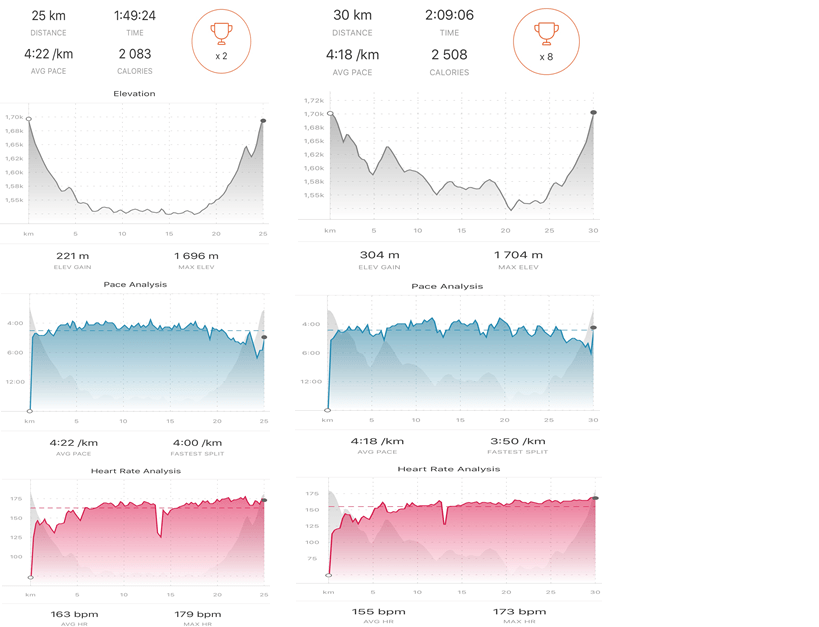
Below are two running sessions I did with a sub 6hr Comrades runner in the beginning of the year while he was building for the big day.

The Strava segments below are quite straight forward. Both are controlled runs. The one on the left was a 25km run 221m of elevation at an average pace of 4:22. The average heart rate for this run was 163 BPM (Beats Per Minute) as shown in the heart rate chart below.  On the right side is a longer route of 30km with much more elevation and you will notice the pace for the 30km run was faster than that of the 25km run. However, the interesting part is that the slower paced shorter run with less elevation had a much higher average heart rate.  A difference of 8 BPM which is quite significant. Someone said its because you were fitter in the second run, but not, as these were a week apart and fitness doesn’t change that rapidly. The main reason is that the average temperature in the first run was hotter than in the second run. Temperature increase equates to higher heart rate, higher perceived effort which spins into the slower pace.


The above is purely a graphical representation of how at Comrades Marathon if you did feel like you were in control of the pace due to effort you might have gone slightly faster under cooler conditions without realising it as it was cooler on the day.  If this is the case and your muscles were not conditioned for the faster pace over time I can with absolute certainty say the muscles were going to fatigue earlier on and your race would be a sufferfest from that point on. You need to understand how temperature affects the body under stress and adjust pace accordingly this could be one reason for having a bad day out.

Pre-Race Fuelling
I have witnessed the most horrific fuelling strategies on race day and seen how sick people get on the course. The interesting thing is it all starts with the pre-race meal on the morning of the race. Firstly, the meal needs to be tried and tested and many runners suddenly do a switch on race day which can lead to major discomfort later.

Whether a low carb or high carb eater I always advocate a meal of around 1-4grams of carbohydrate intake per a kilogram of body weight around 1-4hrs before an event.  The lower end if you are a lower carb eater and only if you have tried and tested it you can go to the upper end but a higher intake closer to the 4hr mark and lower intake closer to the event. Secondly, we are talking very easily digestible carbohydrates, low in fibre so as not to irritate the bowels. I advocate protein intake as well for long events and would look at a 3:1 or 4:1 carb to protein intake and if you do consume protein then easily digestible lean protein (low to no fat) nothing heavy that would sit and create discomfort. I am not a fan of high fat intake prior to an event, it takes a long time to break down and it can lead to the onset of GI (gastric intestinal) distress during the race. At 2am each year I join the masses in the hotel breakfast room and watch with curious intent at what each person is consuming pre-race. I don’t look at it emotionally I look at it from a performance perspective. Very often I can see by what an athlete consumes whether they will have a bad day or good day out as that can be the first mistake they make on race morning. If you had a rough stomach day think back to what you ate on race morning. It might have been something simple like oats which you might have had before but the question then is which oats did they use? How did the cook it? In water or milk? If milk which milk low or high fat? How long before was it prepared? All these factors can influence a 90km trot. Best is to be prepared.

Race Fuelling
An ultra-marathon is tough. It’s tough on the body and tough on the mind. It’s a long journey which requires optimal fuelling. On Comrades day pace and preference will determine fuel intake. The elite athletes I work with will have liquid feeds on route as their airways need to remain open at all times to allow maximum oxygen uptake to support their efforts. The slower back packers can easily afford to chew or bite on food solids and often walks through water tables allow for this.

The two biggest mistakes in fuelling on race day are over fuelling and nutrient timing.  Let’s look at over fuelling first. Taking in too many carbohydrates during an endurance event can certainly lead to digestive discomfort, but it can also lead to nausea and dizziness. Finally cramping can be triggered by a glucose overload in that it can cause an overly hypertonic environment in the digestive tracts and mitigate optimal fluid uptake from taking place leaving the muscles depleted and in a very unhappy state. How many grams of carbohydrates did you consume per an hour on race day? I feel anything between 30-60grams is more than enough for a runner. Some athletes do go higher and anything on the high end will have to be tested way before race day to see how the digestive system copes with the volume of carbs consumed. It’s not about how many carbs you stick in your mouth but more about what the body is capable of absorbing and processing for use.  How do you prevent over consumption and still maintain a steady flow of energy and remain comfortable? It’s quite simple it’s about nutrient timing and it’s called drip feeding. Split the feeds into smaller more frequent meals over time to allow for the already stressed digestive system to absorb and use the intake without causing any havoc. Over and above that you will be shortening the peaks and troughs of the blood sugar rise and fall, and this will allow for a more balanced energy effect. So, when consuming a gel its better to go with a third to half of a gel every 20-30min as opposed to one gel every 45 minutes. The next statement I am going to make might upset a few runners, but a gel is not a suitable feed for a slow runner over a long period of time. We hardly feed the elite athletes gels on route, they prefer a more balanced approach to fuelling and try to combine the hydration and fuelling together by using various prepared solutions on route which start off more hypertonic in nature when cold and then slowly evolve to isotonic and hypotonic solutions when the temperatures climb later in the event. Options on route are a must as with weather conditions you never know what to expect over time. Comrades marathon isn’t primarily a glycogen fuelled effort but more of a fat tank fuelled effort and so I advocate fuelling accordingly to maximize fat oxidation. If you are not sure about the human fuel tanks used during sports performance, then check out my video on Getting into the Zone where I explain how they work.

Protein Intake
Did you take in protein on the Comrades route? I can promise you if you didn’t then the fatigue would have set in a earlier than an athlete that did take it in. In fact, all the front runner elite athletes we fed on route were mainly fuelled with a protein shake I made up specifically for them, including Bongmusa Mthembu the winner on the day. I used 32Gi Recover 2 scoops to 200ml of fluid with 95mg of caffeine in the form of TrueStart Coffee mixed into it. Why did I do that? Simple I want the runners to get in around 5-6grams of protein minimum per an hour with the carbohydrates in the mix. (check out my video on 32Gi Recover discussing the need for it during an event) Nutrient delivery is optimal, and the intake of protein can lead to the delayed onset of muscle fatigue by delaying muscle protein catabolization as well as keep any hunger at bay. On average an elite athletes will take in around 6-12grams of protein per an hour and around 20 – 50grams of carbohydrates and anywhere from 95-120mg of caffeine. What is interesting about this number is it’s not high at all and yet it’s perfectly suited to the winning performances we see every year. Most slower runners consume way more. The slower amateur athletes I did advise to consume protein on route at least at the 30-40km mark and then 50-60km mark all gave very positive feedback as to how it was a game changer for them on the day and how much they enjoyed the feeling of it. It certainly made a difference on the day.

Hydration
Hydration to me is the more crucial aspect of Comrades Marathon in that you have sufficient fuel in your natural fuel tanks in the form of glycogen and fat to get you to the finish line and hydration will play an even more important role on the day. It is not possible to replenish all the fluid lost in the form of sweat during exercise, but we aim for an 80% replenishment. To do this water consumed on its own will not achieve this as it has a slower absorption rate than a mineral or isotonic carbohydrate drink. When I feed elite athletes, I do not allow pure water consumption unless it’s with some sort of a carbohydrate or mineral rich product which will help pull the fluid out of the digestive tracts into the system. I prefer a hypotonic drink as a means of hydration as it is designed to maximize fluid absorption. Drinking water on its own will sit in the stomach and take its time to get out if there is nothing assisting it. This can lead not just to stomach discomfort and a washing machine effect with fluid sloshing around inside, but it can also place strain on the kidneys and could ultimately be a trigger of hyponatremia (overhydration) which can lead to illness and in severe cases death. In our case we use 32Gi Hydrate for seconding which is a pure electrolyte solution with a decent sodium content to ensure rapid fluid absorption. (Check out my blog on Hydration to get more in-depth understanding)

Caffeine
Did you take in caffeine on race day? It can be in any form and many forget that even coke contains caffeine. So the low down on caffeine is such. Firstly it needs to be tried and tested, it is acidic and if you don’t tolerate it well it can cause digestive issues. Secondly caffeine is one of those stimulants that once consumed will metabolize over an approximate time of 60 minutes meaning that once you get the rise you will get the fall. If you start taking it in you need to keep taking it in prior to the 60 minute life, otherwise you will hit a downer. When taking in caffeine understand once you start you need to keep going. Some runners will take much later in the race when they need it and there are those that take all the way through. If you did consume caffeine early on but did not continue with it you might have felt the dreaded crash.

Every year on Comrades route nausea and cramps takes its toll on the masses of runners that haven’t practised proper fuelling strategies and have just read the packaging directions on a product. The problem is the packaging on a product does not know you are running a 90km run over so many hours and so it is of prime importance to ensure you have planned, tried and tested your fuelling strategies under various conditions before you get to race day to ensure you don’t land up in the pitfalls of the many that do.

If Comrades was a good day out for you that’s great and maybe you had everything properly planned or you did fall victim to some of the issues on race day and managed to overcome them. Possibly you can do much better next year with a better prepared and properly planned strategy to tackle the up run. If you were one of those that had a miserable day out I can pretty much bet, you were under prepared from a training and or nutrition perspective and this is your opportunity to think very carefully about how you can better tackle an ultra-event the next time you do.

In the meantime well done to all the finishers, recover well and yes this does require proper nutrition as well 😉. Get proper rest and begin an active recovery program when ready and make sure you plan better for next time.

All the best

M

Mark Wolff is a certified sports nutritionist and an endurance nutrition and physiology expert with over 20 years experience. An endurance multi-sport athlete with a triathlon, mountain biking and weight lifting background, he works extensively with professional and amateur athletes in a variety of sports disciplines as well as those just wanting to change their lifestyles. He firmly believes that a person can only reach their full potential when their health and nutrition is down packed. Mark’s focus on nutrition and physiology is not just on training and racing, but he places major emphasis on recovery, immune system health, emotional stability, stress management and performance. Mark is co-founder of 32Gi a sports nutrition company, focused mainly on health and endurance nutrition.


Categories
Nutrition Performance Training

COMRADES MARATHON – THE FINAL DAYS – The 48hrs before & Race Day Fuelling

In the previous blog we discussed race week nutrition and hydration. In this final blog I am going to focus on the 48hrs up until race day including race day itself. If you missed the previous blogs then just click here to access

For me personally the two days leading into any race requires planning in order to ensure I limit any stresses and can completely relax and focus on the big day.  I have a plan for sleeping, eating, race kit & preparation so that the last days before the race I can completely relax.

As mentioned in the previous blogs my menu for the days leading up to the event is completely planned. Wherever I have travelled in the world to race, I know exactly what to eat, how to hydrate and remove all the pressures associated with last minute race planning because its already been done. If you fail to prepare then you can prepare to fail. No need to cram everything into the last minute and make mistakes.

48 HOURS BEFORE RACE DAY
The 48hrs prior to your race try to give us much focus to sleep, hydration and nutrition as possible. Keep the feet up nicely and allow them the much needed rest before tackling the gruelling event. If you do go to expo in the 48hrs before the event then please try not to spend too much time there. I stand at expo’s a lot and watching runners shopping for hours on end is just madness so close to a race. Limit your time on the legs or you will definitely land up fatiguing them. Expos are also famous for unhealthy fast food and beer drinking. Don’t get caught up in this. The amount of food passing through the kitchens each hour and the conditions in which they are managed is less than stellar before a major event. Take with water to the expo so when you are queueing you are hydrating as you never know how long you might land up being in the line for an potentially being exposed to the sun. As for the beer, its dehydrating you for sure and being in a dehydrated state before an event is not the place you want to be. Take with some snacks as well so that you can keep your stores nicely topped up at race registration.

Eating or drinking something that doesn’t sit well with the body can cause digestive issues, illness and dehydration and it can lead to a really bad day out. For example if you are lactose intolerant do not compromise and consume any dairy steer clear of it. In many athletes red meat sits heavily in the stomach, so if this is the case with you avoid heavy proteins and rather eat lean proteins or plant based proteins. Finally do not try any new foods before the event stick to what you know and what agrees with you. Do not overdo it with stimulants especially caffeinated drinks such as coffee as they do have a diuretic effect and can also lead to sleep disturbance. You need to get a few good night’s sleep before the race, so you don’t want to impact your sleep by taking any stimulants which would impact it at night.

Some athletes deplete carbohydrate stores closer to a race and then slowly build up that carbohydrate intake to maximize their glycogen stores. Don’t try this if you’ve never tried it before. There is no reason to overeat carbohydrates in those hours before an event because your glycogen stores will be topped up with reduced volume in training and it’s not going to make a major difference on race day. Overdoing it will just lead to weight gain and discomfort.

24 HOURS BEFORE RACE DAY
Nerves are beginning the months of preparation are now coming to the big test. Friday night is the night you want to get a really good nights sleep and if you can extend it the following morning that’s absolutely fine. You wont be sleeping much the night before so get in as much sleep as you can the day before.
Plan to eat nice consistent meals the day prior to the event. You can up the carbohydrate intake slightly but keep the eating controlled and manageable do not overeat. Hydrate consistently and try to avoid consuming anything that has a diuretic effect.

Many athletes tend to eat a large meal the night before the race in order to really top up glycogen stores. I feel this is not necessary at all and can in actual fact be more damaging. Consuming a large meal the night before race day will set off some digestive discomfort and will impact your ability to sleep properly. Sleep is more important than overloading the digestive system. As for hydration do not drink a lot before sleep that night. Hydration should be done through the day. Drinking too much before you go to bed is just going to impact your sleep even more by forcing you to run up and down to the bathroom. If you want a slightly larger carbohydrate meal before the event then do it at lunch time, but keep the night time meal nice and small. I also would not advocate eating out the night before. I have seen many athletes eat hotel room service or take outs only to succumb to the ills of a bad stomach or nausea the next day. Plan your meal properly.

RACE DAY

THE PRE-RACE MEAL
A lot of athletes tend to not eat before a big race, but it is the most crucial meal of the day.

What you take in on the morning of race day is going to play a very important role in fuelling you during your race. I suggest eating a meal that will provide you stability and give you the energy requirements that you need during the event.

In looking for the most appropriate pre-race meal the food firstly needs to be something that you are used to and have eaten previously. Do not try anything new on race day. Generally, I advocate a slightly higher carbohydrate meal, unless you are a high fat low carb eater (banter). Depending on the kind of diet that you follow you need to try and keep it simple and healthy. The best time to eat would be at least a minimum of two hours before the event start so that you have enough time to allow the food to digest and the stomach to settle. However many get up very early to drive far to the start and in this case I would look at an additional 100 Calories for every additional hour you eating before the event.

Depending on your weight, a meal between 200-400 calories (depending on weight and time consumed) should be more than sufficient from an energy perspective at that time of the morning. If you are too close to the start time, then reduce the calorie intake accordingly to ensure that the digestive system maintains a level of comfort in the early part of the race.

If you eat breakfast early and its a smaller manageable meal then you can always take an easily digestible food on route with you to the start such as a banana and eat a little more before the event.

DO NOT skip your pre-race meal it is the most important meal of the day. I often get asked what good meal examples would be as a pre-race meal and this is how I would go about planning it.


  1. Do not eat what doesn’t agree with you and what has not been tested previously.
  2. Start with the carbohydrate content and keep it simple and easily digestible.
  3. Ensure the carbohydrate selected doesn’t spike your blood sugar but provides some form of stability.
  4. Keep the fibre as low as possible (high fibre can irritate the bowels)
  5. Protein can assist in delaying onset of muscle fatigue in long endurance events and I would suggest adding in a little to your pre-race meal.
  6. Fat can also be added but I would opt for the type of fat that provides more easily accessible energy, and, in this case, medium chain triglyceride’s are best.


Examples of a pre-race meals could be a gluten free rolled oats, nut butter and some banana or berries. You could eat some banana on low fibre bread or toast, sweet potato, rice or quinoa pudding or oatmeal, spelt or sorghum pancakes. Eggs on toast with a little avocado is also fine, it really depends on the kind of person you are, what kind of diet you follow and what you are used to consuming pre-exercise If following a low carb lifestyle, you can opt for a higher fat meal (the larger portion being medium chain fats) however, I would still advocate a stability carbohydrate before and keep the protein intake small.

Remember, what you eat before the race is going to help fuel you during the race and you need to start your ultra-distance event with topped-up fuel tanks.

THE CAFFEINE BENEFIT

Caffeine is a stimulant and it is beneficial in endurance sport. It has been shown to aid performance when consumed correctly. Caffeine provides mental focus and in any endurance sport this plays a crucial role in sports performance. It is recommended to consume 1-3mg/kg of bodyweight around 2-4hrs before an event. Coffee is not a good measure of caffeine unless it’s a coffee like TrueStart Coffee where you know exactly how much caffeine there is per a serving. Caffeine intake must be measured. It should also have been tried and tested in training to understand how the body responds.

When heading off to the event, make sure you do hydrate sufficiently, but do not over-hydrate because at that time of the morning it’s very cool and the last thing you want to do when the event starts is have that heavy stomach feeling and overloaded bladder forcing you to run to the toilet.

RACE FUELLING

Race day fuelling needs to be properly planned and you should have practised this in your training. If you haven’t, you have completely fallen short of preparing properly for the event because nutrition is a make or break.

You cannot just rely on the nutrition that’s on the course if you haven’t tried and tested it. The best way to fuel in an endurance event, specifically a Comrades Marathon is to make sure you separate your hydration and your energy requirements. Think about hydration in terms of what’s going to keep the body hydrated not about energy. Hydration has been spoken about extensively in the past and if you are not sure you can read my blog Simply Hydrate to get a more in-depth understanding.

As for energy requirements you need to know how much you’re going to be consuming in the form of grams of carbohydrates per an hour during the event to give you the optimal fuel to perform. A large portion of your energy requirements will come from your internal fuel tanks being glycogen and fat, however by taking in the appropriate volume and type of fuel you can assist glycogen sparing and keep your primary fuel tanks lasting longer. To get an understanding of the internal fuel tanks and usage check out my video explanation Get In the Zone.

Most athletes will consume their energy in the form of carbohydrates and you should have by now practised the volume intake of carbohydrates you require per an hour to keep you sustained through the event. Runners have a more sensitive digestive system due to it being a higher impact sport than cycling so I do advocate smaller feeds, more frequently, as opposed to bigger feeds spaced further apart. The reason for this is twofold firstly the digestive system can cope better with smaller amounts of food at a time and more easily utilise and absorb it as opposed to dealing with a very large amount of fuel at once. Secondly it provides more energy balance. I call this the ‘drip feeding’ method, and I find it works very well for most athletes. Remember Comrades Marathon is primarily a fat tank fuelled event, its pace controlled so more oxygen to the system will allow for a better ability to burn fat for fuel. If you over consume carbohydrates you will give too much rise to insulin levels, mitigating fat burn and landing up on a roller coast ride eventually leading to potential nausea and even cramping if there is a glucose overload.

Fuelling every 20-30 minutes as opposed to every 45 minutes to an hour would be a lot easier on the digestive system and it would allow you to balance that energy system out a lot better. In other words, clock feeding and making sure you do take something every 20-30 minutes. This will ensure  better insulin response as well as less gastrointestinal distress and more manageable absorption in the digestive tracts.

Some runners can get away with as little as 20-30g of carbohydrates per an hour and some need to take a lot more, but anywhere between the 20g-60g mark would be fine based on individual requirements. Remember to stick to what you have done during training. It is not about the amount of carbohydrates that you’re taking in, it is about what your body is capable of absorbing and utilising. Anybody can consume a large amount of fuel, but it does not mean that the body is going to utilise and absorb it and this can lead to severe digestive issues. If you take in too many carbs overdoing it with the sugar and glucose, it can lead to muscle cramping mainly due to poor fluid absorption. It can also lead to dizziness and nausea and it’s the last place you want to be during a race.  My advice is to take in the least amount of fuel to achieve the greatest possible result.

Caffeine during the Race

Caffeine during the race can play a benefit as well. Caffeine does metabolize fully over a period of around 60minutes, so my advice is to have measured doses throughout the event once you do start consuming.  I recommend at least once an hour some athletes consume every 30 minutes, but this is something that needs to be tried and tested in training to see what the optimal dose is for you during exercise. Caffeine has shown to improve performance especially in the form of mental focus and in a long endurance event the mind needs to be focussed and strong.

Protein during the Race

An absolute must for Comrades Marathon is protein consumption on route. If you’re going into an ultra-distance event and it’s going to be a lot longer than 4-5 hours, you should incorporate protein consumption on route, just to help act as a buffer and assist in delaying the onset of muscle fatigue. It also helps satiate you, in other words, it gets rid of the hunger pains and it does break up that intake of glucose. I would highly recommend a 1:3 protein to carbohydrate ratio which has been shown to maximize the delayed onset of muscle fatigue. If you want to know more I have recently done a video on a protein we fuel our gold medallists and elite athletes on route and it works extremely well.  Click here for information on which protein to consume.

Please make sure that you are prepared from a race nutrition perspective. If you’re not prepared, you better start thinking about it very soon and make sure you’ve got some sort of plan for the big day. On the day, stick to your plan, don’t deviate and you will get to the finish line feeling a lot happier and a lot more comfortable. DO NOT try anything different or new on race day.

I wish you all the best of luck, may you have a great race.


all the best

M


Mark Wolff is a certified sports nutritionist and an endurance nutrition and physiology expert with over 20 years experience. An endurance multi-sport athlete with a triathlon, mountain biking and weight lifting background, he works extensively with professional and amateur athletes in a variety of sports disciplines as well as those just wanting to change their lifestyles. He firmly believes that a person can only reach their full potential when their health and nutrition is down packed. Mark’s focus on nutrition and physiology is not just on training and racing, but he places major emphasis on recovery, immune system health, emotional stability, stress management and performance. Mark is co-founder of 32Gi, a sports nutrition company, focused mainly on health and endurance nutrition.

Categories
Performance Training

COMRADES MARATHON – THE FINAL DAYS – The Do’s and Don’t’s (Part 1)

Comrades marathon is just around the corner and with the final days approaching the training is basically done, the fitness levels are banked and now all you can do is get to race day healthy, in good shape and ensure your nutrition and sleep is spot on over the next week because that is now going to be the biggest difference you can make on race day.

I am going to give you a number of tips on how to approach race day properly to guide you to your best day out.

Lets take a look at the important aspects of the final few days.

  1. The Do’s & Don’t’s
  2. Race Week Eating and the Carbo-loading debate
  3. The Hours Before Race Day
  4. Race Day Fuelling –  Carbohydrates, Hydration, Cramping and Caffeine

In this first part we talk about the basics and the Do’s and Don’t’s as we get closer to race day.

SLEEP
Sleep is without a doubt crucial. Its the time when the body needs to recover. Very often athletes underestimate the importance of sleep and the critical role it plays in sports performance. Sleep is the time where the body repairs and restores. Its a well know fact that “sleep deprivation leads to depression, high blood pressure, weight gain, heart disease, and probably mortality,” says Dr. Steven Feinsilver, the director of the Center for Sleep Medicine at Mt. Sinai School of Medicine in New York City. Additionally, a 2012 study detailed how sleep deprivation increases a person’s risk of developing Type 2 diabetes. Earlier studies have shown that reaction time nearly triples when a person pulls an all-nighter. Normally about a quarter of a second, it increases to 800 to 900 milliseconds. It’s about the same as the difference between being sober and being legally drunk. For elite athletes, emergency room doctors, and cab drivers, among others, losing that half of a second is costly never mind minutes over many hours due to the inability to focus due to poor cognitive function and physical fatigue.

If night sleep is still limited then try adding some power naps during the day. It’s been shown that taking in a large amount of caffeine before  power nap is best as consuming caffeine will eventually pass into the small intestine and get absorbed into the blood stream. It then begins a chemical reaction in the brain which blocks the receptors which are filled with Adenosine (energy transferring molecules) which actually cause drowsiness. Adenosine will make you feel very sleepy and by consuming caffeine the opposite happens when it binds to the receptors. This will trigger an effect of alertness and focus. Many people that have a power nap feel lethargic afterwards but the 20 minute coffee nap as we call it will allow you to rest for a nominal time with a feeling of energy after.

Over the next days you should ensure you give yourself complete focus on getting the most sleep you can each night to ensure your body and mind are ready for the big day ahead.

NUTRITION
The training now will be behind you but the nutrition is far from over. Training your gut, in other words eating correctly is paramount to arriving at your race healthy, in good shape and ready to tackle it.

Lets start with what you must avoid first in leading up to race day.

Lay off the Alcohol in Race Week
Make sure you hydrate properly. The recommendation is 30-40ml of fluid per kg of body weight and that is not by any means alcohol. Do not consume anything that would dehydrate you. If you do drink alcohol, keep it out of race week. It will impact you on race day, there’s absolutely no doubt. Alcohol pulls the fluid out of the system and dehydrates you and this is something you definitely want to avoid.

Avoid too much Caffeine
Coffee and tea can also have a diuretic effect and it would be advisable to keep this to a minimum. Stimulants also caused sleep disturbances and it would be best to keep these to mornings as opposed to afternoons to ensure you get a good nights sleep without any impact. If you plan on using caffeine on race day then it would be best to minimize your intake prior to race day to ensure you get the best benefit possible. Being overly tolerant to caffeine will minimize the effect it has during the race.

Avoid Eating Out
As much as possible try to ensure you are in complete control of your own nutrition. Eating out can put you at risk of digestive issues or potential illness. The more prepared you are and in control of your own eating the far lower the potential for any food triggering discomfort. Many athletes travel to foreign cities to race and in this case you should plan ahead and make sure you take with foods which you would generally consume and are used to. Trying foods because they are available and you don’t have a choice will only place you at risk. I’ve often seen people get stomach bugs close to an event due to eating out or consuming foods they are not used to.

If you could not find a hotel or accommodation where you have got the ability to self-cater it makes it a lot easier to take with your own food and not be stuck without decent options. If you are in a hotel and they’re not cooking foods to your liking, ask for foods that do agree with you or take a page out of my book where I go into the kitchen and do it myself or use powdered based foods where a hotel kettle is all that is needed to prep.

Avoid Overeating
Tapering for an event means lowered training volumes which equates to a lower calorie burn rate which means lowering your calorie intake and not over eating. This is one of the biggest mistakes athletes make in that they land up eating in excess of their calorie burn rate and actually land up gaining weight for race day. This is a problem as it means placing more stress on the body due to doing the event at a heavier than training weight which will only lead to issues and possibly more pain and suffering than you bargained for.

No to Sugar
Keep the sugar out of the nutrition equation please. Pastries, chocolates, sweets and other forms of sugars should be avoided as much as possible. It just creates havoc with the energy system and can trigger cravings leading to roller coaster riding, energy level dips and physical and mental fatigue patterns.

Avoid Processed Foods
Processed foods should be avoided at all costs. They mostly contain an abundance of unhealthy hydrogenated fats, sugars and additives which play havoc with the body. Opt for natural foods which provide benefit to the body and not foods that are detrimental to your over all health and well being.

Now lets take a look at what we should do leading up to the big day

THE DO’S

Eat Healthy
Eating nutrient dense meals which provide benefit are always the way to go. Incorporate a nice mixture of foods which are high in antioxidants, healthy carbohydrates such as nutrient rich vegetables and fruits, lean proteins and healthy fats to keep the immune system strong and the body energized.

Eat Consistently
Try to eat consistent regular meals as opposed to overly large gaps between the meals through the day. The body requires nutrients to keep it fortified as you head towards race day and its not a good time to place it into any form of starvation mode prior to a race.

Hydrate Constantly
Hydration is one of the most critical factors around any sporting event. To arrive at race day completely hydrated is important. You don’t want to be in a dehydrated state. You need to eliminate anything that would possibly dehydrate you as mentioned above anything such as diuretics excessive intake of stimulants such as caffeine and or alcohol certainly will.

Proper hydration requires regular fluid consumption preferably in the form of water or a hypotonic solution
( hydration solution such as 32Gi Hydrate) want more info on hypotonic drinks then click here

In part 2 of my Comrades Marathon prep we will discuss carbo-loading the pro’s and con’s as well as race week nutrition.

all the best

M

Mark Wolff is a certified sports nutritionist and an endurance nutrition and physiology expert with over 20 years experience. An endurance multi-sport athlete with a triathlon, mountain biking and weight lifting background, he works extensively with professional and amateur athletes in a variety of sports disciplines as well as those just wanting to change their lifestyles. He firmly believes that a person can only reach their full potential when their health and nutrition is down packed. Mark’s focus on nutrition and physiology is not just on training and racing, but he places major emphasis on recovery, immune system health, emotional stability, stress management and performance. Mark is co-founder of 32Gi, a sports nutrition company, focused mainly on health and endurance nutrition.