Categories
Nutrition

The Tru Magnesium

Often I get asked by people what supplements they should be consuming. My general opinion when it comes to supplementation is that it’s just that “supplementation”. I always advocate that the proper vitamins and minerals to ensure your system functions at its optimum can mainly be acquired from proper nutrition. There can be no substitute for real nutrient dense foods. If you are not eating correctly then your body doesn’t deserve supplements. It might sound harsh but I always put health first and there are no quick fixes.

With that in mind what about those that actually do eat balanced healthy meals and exercise. One of the minerals that constantly comes to mind is magnesium. Magnesium of course exists in natural foods, pumpkin seeds, almonds, Brazil nuts, spinach rice, sesame seeds and the list goes on. Even though the magnesium found in these food sources are fairly high the volume and frequency with which they are eaten does not offer a fair supply to someone who is very active in particular an endurance athlete.  An athlete following a LCHF (Low Carb High Fat) diet, such as myself consumes these types of foods in abundance but is it sufficient?

The answer to that in my opinion is not. In all the curiosity surrounding magnesium I decided to run some blood tests. The two types of tests run are serum magnesium and red cell magnesium. In any persons case serum magnesium is critical for heart function, if it’s too low or too high you risk cardiac arrest, but this level is pretty much controlled at the expense of magnesium in the cells. Generally when a typical blood test is done it’s the serum magnesium levels that are measured and not the red cell magnesium. This is a problem as it doesn’t reflect the true status of where your magnesium levels need to sit. I insist on a red cell magnesium count, this is what you should be focused on.

In my case even with an incredibly clean diet high in magnesium rich foods, my red cell magnesium count was truly on the very low end and I was actually not surprised. I noticed it specifically worsen during harder weeks when bouts of physical fatigue or tiredness set in. The solution of course was to supplement. I know you are going to ask me if I had a low magnesium count prior to supplementation and the truth is actually not. What I discovered is that my magnesium levels were not purely dependent on what I ate, but also the volume and intensity of exercise that I performed at.

Why Exercise and Magnesium?
Quite simply, athletes need more nutrients than less-active people. We demand a lot more from our bodies than the average gym goer and there is a need to compensate with the right nutrients from foods first then supplement to ensure proper physical health, performance and recovery.

Magnesium is a vital nutrient in many of the body’s chemical processes and is required in nearly every single cell in the body for proper function. Magnesium plays a crucial role when it comes to energy production. It is a major element required for the body to produce ATP (adenosine triphosphate) which is basically what fires the muscles and gets them to function. Low magnesium in the cells will ultimately lead to lowered ATP production which will equate into fatigue, cramping, reduced power and nausea.

Some scientific studies on magnesium have found that endurance athletes that supplemented themselves with magnesium were able to perform at a maximal intensity for a longer period time and also had increased VO2 max.

There is evidence that magnesium requirements are elevated in athletes, and that performance can benefit from higher intakes. Aside from being used up in the production of energy, magnesium can also assist performance by reducing accumulation of lactic acid and reducing the perception of fatigue during strenuous exercise through its action on the nervous system. Magnesium is also lost through sweat so an athlete training in a hot and humid environment will probably require more.

Magnesium deficiency is quite common especially among the athlete population. This is mainly due to poor eating habits and also rigorous exercise where the magnesium demand is just not met. Magnesium is not produced by the body, it needs to be ingested daily through the consumption of magnesium rich foods and in an athlete’s case recommended supplementation.

The Test
I began supplementing my diet with magnesium and after 2-3 weeks I began to notice an major difference in my energy levels, ability to perform and also better sleeping patterns at night (I monitor my sleep with Azumio Sleep Time ). There was a noticeable difference and I will even put myself out there to state it was a major difference in my performance ability. A re-test of bloods 8 weeks later showed my red cell magnesium levels had climbed and it directly correlated with how I felt.

What magnesium supplements should you take?
There are so many different magnesium supplements on the market and it’s good to question what you should be looking for when it comes to selecting a magnesium supplement.  The most important thing to consider is the bioavailability and concentration of the product, in other words how much actual magnesium is there and of it how much will actually be absorbed and utilized by the system. Magnesium Citrate has been shown to have one of the highest levels of bioavailability, but a low concentrate of magnesium whereas magnesium oxide is highly concentrated but lower on the bioavailability end. Magnesium chloride lies in the middle of these two and it has moderate concentrations of magnesium but a fairly decent bioavailability. There are others but the ones that should be avoided are magnesium glutamate and magnesium aspartate they become neurotoxic due to lack of amino acid binding. Of course the preparation of the mineral will ultimately determine the outcome of impact and absorption.

What is meant by preparation?
Magnesium can of course come in its raw format often encapsulated of or coated such as an enteric coating which slows the breakdown of tablet to ensure it reaches the lower bowels where absorption is maximized. In truth this does help reduce the risk of stomach irritation by processing it lower down in a less acidic environment.

Typical magnesium absorption involves:

  • 40% of magnesium intake absorbed in the small intestine
  • 5% absorbed in the large intestine
  • 55% leaving the body as waste

Depending on the type of magnesium ingested and the magnesium status of the individual, these figures can be higher or lower. Studies have shown overall absorption of magnesium in some individuals as low as 20%.

Aside from the delivery mechanism many magnesium supplements are bound with other minerals such as calcium or zinc. Some companies that manufacturer magnesium/calcium combination supplements promote a 2:1 or 3:1 ratio as being ideal for absorption of these elements. However, there is no credible research to support this claim.

Now recently a new patented formula has been brought to market and this was something that completely caught my attention 2 years ago. A product that I used extensively in testing on myself and many athletes for a period of 18 months.
What garnered my attention was the fact that the patent holder had completed extensive bio-availability testing which demonstrated a 100% absorption rate with the highly concentrated magnesium oxide and magnesium chloride which is known to be lower on the bio-availability side. With magnesium this is unheard of. Generally we athletes take multiple large doses to get the desired result. The second thing that I found highly attractive was the fact that this magnesium supplement had a consistent release time of 8 hours. Yes, you read correct, 8 hours. Meaning that consuming this would ensure I was getting a consistent and stable release of magnesium over a long period of time and this is what made it highly bioavailable. Then a third element popped into the picture which closed the deal.

This magnesium compound was infused with L-Carnitine. This completely switched me on. L-Carnitine is critical to an endurance athlete. It transports long chain fatty acids into the mitochondria for ATP production and it also transports short chain fatty acids and metabolites out of the mitochondria. In simple terms it carries fat to the cells to be used for energy as well as slowing down lactic acid build up (it acts as a buffer). As a minimalistic fueller that predominantly relies on fat for fuel this was a shining light.

I decided to put this to some ultimate testing. Not that I didn’t trust the doctor who invented the product, but as an athlete I needed to experience it for two main reasons.

–          Digestive Comfort

–          Functionality

I am not prone to cramping and generally I blame muscle cramping on undertrained muscles in most athletes. In my case I wasn’t sure what parameters to set but decided to follow the dose directions and first off verify the impact on my sensitive digestive system.

This passed with flying colors and even under high intensity sessions when consumed prior to exercise there was no negative digestive impact whatsoever. Then within a short period of time I began noticing two major benefits of this patented compound.

  1. I could exercise at a high intensity for a lot longer than previously. There was definitely a noticeable delay to the onset of muscle fatigue
  2. DOMS (Delayed Onset of Muscle Stiffness) was reduced significantly so much so that I forgot I actually had compression garments ;-). In all seriousness after very hard sessions I had a major reduction in muscle stiffness.

After 3 months of testing I decided to give this out to some elite athletes for further testing and the feedback was completely in line with what I was experiencing. Except for one thing which I could not account for was that one of my elite athletes in particular who had a severe cramping issue noticed a difference in that the onset of his cramps were delayed or even mitigated. Once I had completed thorough testing with many professional and amateur athletes there was no doubt that this patented compound had to be made available to the public. This is where 32Gi’s Trumag® came into being.

I have tested many magnesium products over the years in many different variations and forms, but this is definitely a true slow release magnesium formula which has an incredible benefit for any endurance athlete. Another thing I found quite impressive is that for a person that cramps during sleep this becomes a simple solution due to its 8 hour release. It means that your magnesium requirements will be catered for throughout the night.
Trumag is definitely a New Generation Magnesium supplement.

CONCLUSION
In short magnesium supplementation is definitely high on my list of DO’s especially for an endurance athlete. There is more than enough evidence to support the benefits of magnesium supplementation.

I plan on holding a webinar in the coming weeks with the Doctor who invented Trumag® as well as some of the athletes that have been testing it to provide some insight and feedback on the product.
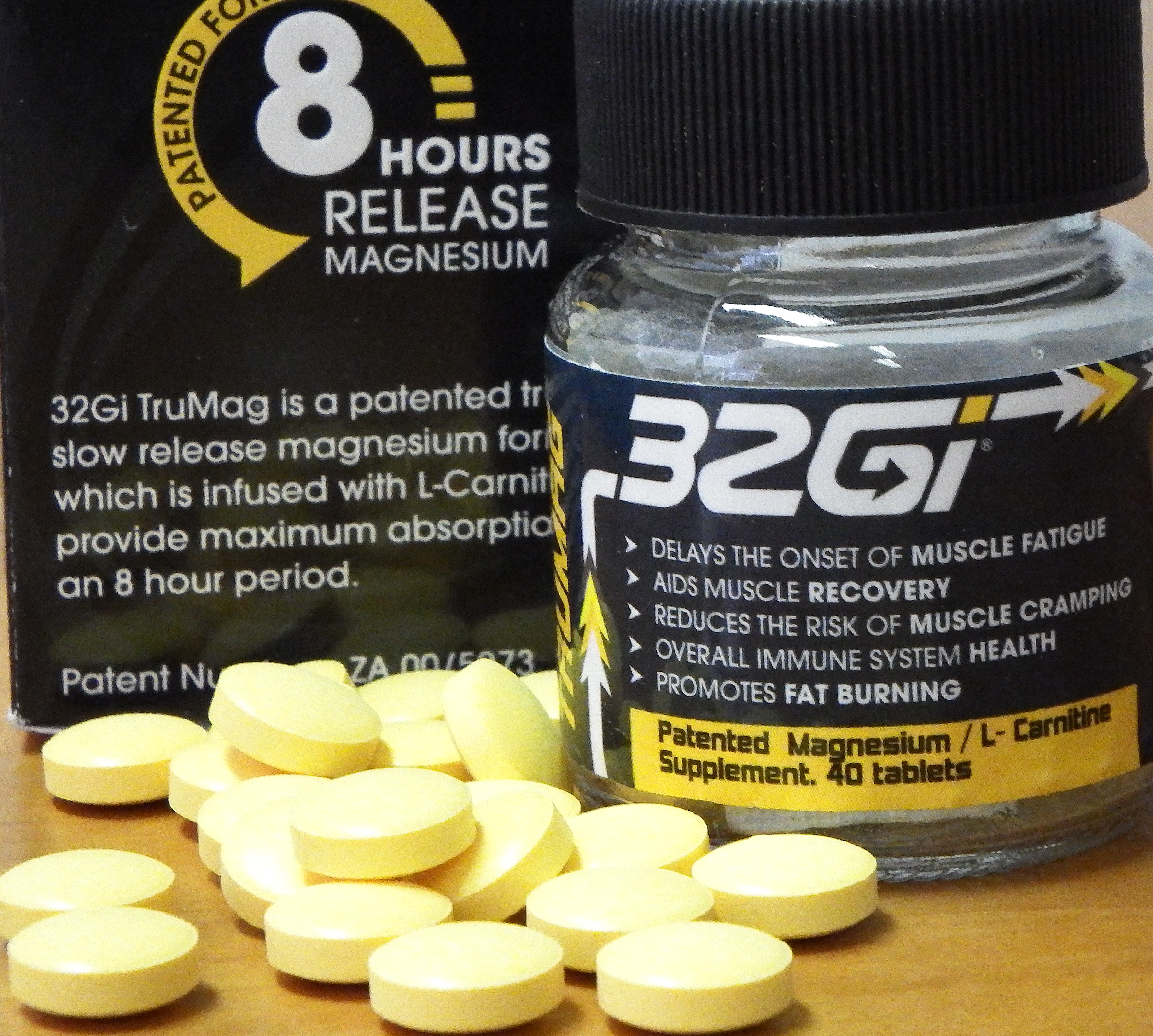
Trumag

ABOUT 32Gi TruMag®

32Gi is proud to announce the launch* of patented TruMag™ a true slow release and 100% bioavailable magnesium tablet.
TruMag™ is a unique fusion of two very important compounds required for endurance athletes, these being Magnesium & Carnitine.
Unlike most magnesium supplements on the market TruMag™ breaks down in the body of a period of 8 Hours and is completely absorbed by the system, making a single dosage extremely effective. The unique patented infused combination of Carnitine makes it a powerful formula for any endurance athlete due to Carnitines unique property of transporting free fatty acids to the mitochondria (muscle cells) to be utilized as a source of energy.

Due to the prolonged release an athlete can take a single tablet prior to a sporting event and know he will be well covered for the duration.

32Gi TruMag is a patented true slow release magnesium formula which is infused with Carnitine to provide maximum absorption

  • Delays the onset of muscle fatigue
  • Promotes Fat burning
  • Aids muscle recovery
  • Assists in exercise performance
  • Reduces the risk of muscle cramping
  • Overall immune system health

*32Gi Trumag is now available at Dischem and rolling out to more stores country wide

Categories
Nutrition Training

“If you fail to prepare, prepare to fail.”

Image

Recently I have been receiving a lot of questions on training and racing nutrition. My last blog was focused on becoming more fat efficient, keeping your fuel intake to a minimum and adapting the body to using its natural fat stores as a predominant source of fuel in an endurance session. It’s an awesome position to be in when you can just get up and go long and not worry so much about fuelling yourself.

As mentioned previously in sessions under 2 hrs you can perform extremely well at a high intensity on no fuel at all, if you do consume anything it’s purely to make your brain happy and give you that extra mental boost to up your performance. This has been shown in the famous “Carb taste not swallow test” where athletes purely rinsed the drink in their mouths without and a percentage increase in performance was demonstrated (The Effect of Carbohydrate Mouth Rinse Cycle Time Trial Performance-Jeukendrup) It shows that the mind has a lot to do with an athlete’s ability to perform and Prof. Tim Noakes has often presented the central governor theory where the brain is completely in control by the body and understands all physiological feedback mechanisms. It determines based on conditioning and ongoing readings it gets from the body during exercise as to what point it will control your ability to perform or under perform in a means of ensuring you are protected. If you are not trained to go out and race at a particular effort, the central governor will surely tire you with feelings of fatigue under those conditions in order to slow you down and ensure the body is safe. There is of course opposition to this theory, but there is one thing that both sides still agree on and that is the body needs to be trained to perform.

Last week on a whim I decided to run 42km’s to celebrate my 42nd birthday. Maybe not a normal thing to do, but my running coach said go easy and get it out the system. Even if he said no I think I would have been stubborn enough to do it. With no race pressure, and not the best night’s sleep, I got up early had a cup of strong black coffee, took a waste belt with two 250ml water bottles and headed out with a friend. I ran at a very comfortable and evenly controlled pace, I got back home in 3h19 minutes with a little water to spare and felt great.

The big question I get asked is how you can go and run for that long and not eat anything, and the answer is simple I had all the fuel I needed for that long run inside me BUT more importantly my body was conditioned and gut trained extensively to do that quite comfortably.
That run probably didn’t touch much glycogen at all, it was primarily fuelled on fat. Also the time of running was way less than say some of the rides I do on water only which can go anywhere between 5-6 hours so it wasn’t a worry.  The point is the body is trained over a long period of time with proper nutrition consumption to allow for this. The brain and body work together to understand the body’s ability and limitations and with time you will understand as your body gives you constant feedback. (Check out a previous blog “Listen to your messages”)

The big questions I got after that is if this is how I will race? My answer to that is absolutely not. This is where the title of this blog comes into play, “If you fail to prepare, prepare to fail”.  It’s very critical to properly prepare for racing conditions as well, and even though I do a lot of water training, I definitely set aside time for what I call racing “nutrition training”. It’s an important area of being able to race at your best. There is no ways any athlete can go into a race not properly prepared for what he has to consume and under which conditions to ensure that he performs at his or her best. Racing is done at a much high pace for a longer period of time than a training session and it requires a different type of fuelling.

It’s not a difficult aspect of training but I need to stress that it’s a critical aspect and something that cannot be left to the last week or two before a race, because you will want to have your race nutrition down packed way before that in order to make sure that you have a plan and you can habitually stick to it.

My recommendation is to choose a day where you test out your race nutrition. This means waking up in the morning eating a pre-training meal as if it was your pre-race meal going out for a few hours at a fairly intensive pace (slightly slower than race pace) and checking the following:

  • Digestive Comfort  
  • Palatability
  • Energy Levels
  • Ability to Perform

I generally do a session like this once every 10 days and know a few elite athletes that will do this once a week. Sessions like this must be planned, well thought out and think about mimicking it close to your race day as possible.

Nutrition of course will vary for each sport discipline and it’s important to understand that what you do on the morning of a 10km race, marathon, triathlon and cycle race can all differ and should be planned, checked and re-tested to ensure you are on track.

If you can finish that session strong and feeling good with all the check marks in the boxes you are definitely on the right track. This does not need to be done too often as you would not want to try and mimic race day efforts too much, but you need to find a winning formula.

If you are doing a stage race it requires even more effort to test your nutrition as you will need to test your day nutrition first, and once happy with it move on to testing your stage racing nutrition. The critical area of stage racing is recovery in order to be able to keep consistent performance’s each day and keeping those energy levels constant. It would be highly recommended to do at least 3 repeat performances each day including pre, during and post racing nutrition which will give you an idea of exactly how you feel day to day and whether your nutrition strategy is working for you.

Each person is unique and what works for one person won’t necessarily work for another so you need to experiment and see what is the best for you.

As a general guideline in deciding what you are going to eat on race day I can suggest the following:

Avoid any Food Consumption that can cause Digestive Issues
There a few foods than entirely ruin a race. You might think they don’t affect you generally so when you are racing they should be fine. However you need to understand that blood i.e.: oxygen is needed to perform digestion. If you are running very fast, oxygen will be diverted away from your stomach to your heart, brain and leg muscles to cater for the exertion. The stomach needs an adequate amount of electrolytes, roughly equal to that of the body tissues outside of the stomach, to perform digestion. If digestion doesn’t occur and the contents of the gastrointestinal tract don’t move, the muscles in the walls of the tract may begin to spasm, bringing on uncomfortable stomach cramps. Triathletes tend to experience more digestive issues than most sport as the positions of 3 disciplines vary. The swim is a lying down position not very conducive to easy digestion and there is buoyancy on top of that, this is usually the setup for cramping that occurs later on during the bike or run. Secondly a triathlete cannot consume during the swim or hydrate so if he or she has consumed something not suitable to that discipline a fair amount of time will pass before the first bit of water can be consumed to try to create some form of balance. In long distance events like Ironman very often consuming a glucose spiking product at the onset will cause GI distress pretty early on. A common mistake that many endurance athletes make.

Running moves the bowels around quite a bit more as the body’s movements gets the organs bouncing and shaking nicely. I am emphasizing that what you eat that’s generally comfortable will still need to be tested during exercise which is what I call digestion under stress.

The main foods to avoid before a race are definitely anything that is high in fiber as this is a certain way of getting your bowels to work nicely and that’s the last thing you need before a race or during it, especially while pre-race nerves are finding their way into every part of your body. Another recommendation I make it to avoid high lactose products. Dairy is a very common cause of digestive problems. Even if you are not lactose intolerant you don’t know what it can do to your body while under stressful conditions. Heavy meats or cheeses are a big no. You want to consume foods that are easy on the digestive system and leave you feeling comfortable.

Size of Meals
Another issue is that many athletes over eat and over hydrate pre-race leaving them feeling bloated heavy and uncomfortable. That is a guaranteed curse under racing or exercise conditions. You need to play with your portion sizes to see what your comfort zone is. I generally recommend a +-300 Calorie food portion pre-race.

Timing and Type of Meals
The timing of your pre-race meal is also critical. I can use a personal example for this one. A few weeks ago, I had a 25km trail race. I made a BIG rookie mistake. I though the start time of the actual race was 7am. There were two races that day and I for some reason just never read the details properly which is not like me, but I was chilled about it nevertheless. I woke up at 4:30am had a nice rolled oats and nut butter meal. I got a lift to the race and on route I get told the race is actually starting at 6am. I was thinking in my mind this is going to be even harder and it was. The timing of my meal to my 7am race was perfect, but to the 6am race it was not. I had to suffer some serious heart burn through the event and I expected to. At least the pain could mentally be bypassed and allow me to come out on top. I am just using this example to stress the importance of meal timing. Preferably minimum 2hrs before the race you want to be done and dusted with your pre-race meal, only requiring some top ups in between. To be honest in this case I shouldn’t have had a pre-racing meal maybe just a small shake or drink before, it wasn’t required at all especially at that time of the morning and I hadn’t run a trail race in years so my nutrition prep was not exactly where it should have been.

I guess this leads into another question. When should I eat a proper pre racing meal and when is it not absolutely necessary. In this case I always look at the type of the event, my pace and expected time. Generally any race for me taking less than 2hrs I won’t eat. I might take a small shake but I certainly don’t require any food. These shorter events as I define them will generally be raced on water. If the pace is extremely high and is closer to the 2hr mark then chances are I will consume some sugary stuff on route to keep my brain a little happier and ensuring a little bit of glycogen sparing on route.

Race Fuel
When events get longer 3hrs or more, you need to understand that at a very high pace you will deplete your glycogen levels and will need to eventually rely on fat as the predominant fuel source. Your body will naturally slow down to cater for the fuel change as fat burning requires oxygen and at too high a pace that’s not going to happen. However this is where fat efficient training plays a massive benefit, because if you have trained your body to adapt to this sort of fuelling it can be trained to do it a slightly higher intensities and this is a great benefit. Also the switch from glycogen to fat caused by glycogen depletion is a shock for some a feeling of fatigue and not being able to move any more. The trained athlete will move through this quite a lot more easily. There is another way around this and that’s to try to pace yourself properly in an endurance event where you won’t burn your glycogen completely and have saved it towards the end where you really need it. In a cycling race it’s sometimes very difficult as the effort or intensity is determined by the bunch and this is where most people get burned, as they are forced to perform at a high intensity to stick with it even if they don’t want to. The wise thing is to try to stick it out in the middle and draft as much as possible to conserve your energy stores. However in an ultra-distance triathlon or long running race you have the ability to determine your own pace and control your intake and predominant energy fuel based on that.

It’s important to remember that if you are going at a controlled pace or intensity consuming a blood glucose spiking product will mitigate you from being able to use your fat stores as energy, so keep fuel intake to lower insulin spiking products which allow for this. When performing under very high intensity conditions you are best suited to taking a blood glucose spiking product as fat is not easily accessible. There of course is a combination of both glycogen and fat being used when doing long events, as pace varies through the event, but fuel intake will ultimately determine this as well, and can upset the balance.

Another point I want to enforce is that endurance fuelling should never be complicated. The simpler you keep it the better. I advocate drip feeding in endurance events. This means smaller more frequently timed feeds as opposed to feeding every hour. It’s easier on the digestive system and it keeps the body and energy levels in a nice equilibrium. I generally will feed every 20-25 minutes in a long endurance event.

Plan and Train the Gut
I was invited to chat to the participants of Ironman 70.3 Western Australia this year as we were event sponsors. The first question I received was shouldn’t we be consuming between 60-90 grams of carbohydrate per an hour of exercise during the event. My immediate response to that was has your gut been trained to consume 60-90 grams of carbohydrates per an hour. The amount of carbohydrate consumption per an hour during exercise is not based on the number of carbs you are consuming, but more importantly how much of those carbohydrates your body is capable of absorbing and using. If your body is only capable of absorbing 50 grams of carbohydrate per an hour because that’s the food you use and that’s what you are used to, then how would your system cope under excessive intake meaning, your gut completely under-trained to deal with the increased consumption. The answer is it won’t. In long endurance events I can easily get away with between 20-50 grams of carbs per an hour in an event. I have never needed to venture into the 60-90 range ever and I don’t feel I would cope in that range either. Another thing that is important to note is the 60-90 gram carb intake is based solely on the fact that you are fuelling with carbs only which means racing at a very high intensity, its doesn’t take into account controlled pace and fat usage. Scientific studies have shown that a combination of specific carbohydrates in unique ratios can maximize the absorption rates however I have witness many an athlete opt for those test results only to be left with severe stomach issues on route. Another thing I don’t agree with is relying on drinking ones calories. I definitely feel that food solids are a far better form of fuelling. Dr Allen Lim well known scientist especially with his involvement in premier Tour de France cycling teams has shown a lot of science behind this and you can view it here.

There are many ways to approach nutrition when it comes to training and racing. It’s something that always needs to be taken into consideration and never left on the side. So the next time you sit down look at your training and racing schedule. Plan your workouts, your swims, cycle and runs, but add another training session into that called nutrition. Train your gut, get on track and make sure you give yourself the best opportunity to perform well and hassle free at your next event.


Keep at it 

all the best

M

Categories
Health Nutrition Training

Listen to your messages……………..

Man-with-hand-to-ear-006

I am a very military oriented personality, just the kind of life I have lead since birth. A naval officer father, nutrition strict mother and then my own life experiences which followed very much similar routes. My clients know when I take them on there is black and white, tolerance levels are low and I demand results.

I travel quite a bit and come into contact with all types of cultures and personalities on many different levels. South Africans generally I see as quite a soft sort of courteous kind of nation, mainly rule followers and breaking them will definitely command some sort of reaction but generally in a very subtle kind of a way to start. In Israel where I currently am it’s a completely different ball game, you can be sure people will be telling you what to do on a daily basis, because they always know better, yet the rules are consistently broken by the big mouths.

It often gets my back up and I am often in a defensive mode which in military terms means strike them down before they even get close to doing or saying something, that way you won’t have to defend. It’s an aggressive approach but generally one that has won many warsJ.

So my resistant personality wherever I am is constantly ready to go to war, don’t tell me what to do or else, because I know my boundaries, I know what I am doing and if I need your advice I will ask for it. Most people tend to similar so I am not unique ;-).

Yesterday I was out on a training ride, I was around 80minutes into the ride, in the country side and just started a climb out of the valley, music in my ears and really just soaking up the view when all of a sudden a car slows down next to me the window open and I can see muttering and hands waving. The sound completely drowned out by some Armin van Burin ASOT in my ears.

My instinctive thoughts was to tell her to shut the hell up and leave me to my training session, I know the rules of the road and I am within my right to ride here. Instead I just ignored her completely she tried several times to shout at me, but Armin kept me calm. Eventually she just drove off and I carried on with my ride.

This is not an unusual situation for me, when running, swimming or cycling, I get told why you riding here, why you running without a water bottle, where is your hat. I know sometimes they mean good but geeeez most of these people have never trained in their lives and they talking to someone that lives it. The frustration of being told what to do just wants to put me into war, sometimes I long for it hoping it will result in vented anger and then some more peace of mind.

Just the other day I was doing a swim session, I did my warm ups and some drills. By the way in South Africa 2 swimmers to a lane is like max, unless you are group training, however in Israel you have to swim counterclockwise, and if you need to overtake then do it with caution because 3, 4 or 5 people can get in your lane without warning, because it’s their right and they know better. I have had many head bashings here and the fast lane means nothing. Even though it’s labelled for fast swimmers you get back floaters, because they consider themselves fast. Anyway back to my story on my swim session. So I get into nice rhythm and start with some clockwork intervals. I was focused on my set, however at around the 4th interval I noticed something strange. Each time I swam passed a woman in the other lane “slow lane” she splashed water on my face as I turned to breathe. I thought ok she is doing some sort of exercise creating splashing, giving her the benefit of the doubt. However as my session continued I realized this was intentional splashing she kept shoving water in my face every time I did a pass. I just ignored her put my head down and finished my set. While taking a breather at the end of the pool I waited for her to reach my side. When she arrived, I asked her why she was splashing me. Of course sniper rifle in my hands ready to take aim and blow her away. She said to me I was splashing her eyes when I swam????? WTF, you in a pool lady wear some goggles and learn to swim. You afraid of water I asked. She said no but my splashes were irritating her and I must get out the pool, and she threw more water at me??

I went a little mad, I unleashed my M23A4 on her, it was locked loaded and I sent a couple of waves in her direction ensuring the water bullets hit her right between the eyes. Of course she carried on throwing water at me. I took a step back and thought no ways, is this what I am resorting to a water fight between 40 and 50yr olds in a pool no ways I was like in shock, like kids having a tantrum in a pool.

I just motioned the rest of my unit “The Lifeguard” and said tell her to stop or get out I need to train. He did just that, war over. I felt an empty victory, thinking could I have handled this slightly differently, but then I thought no screw her, I was within my right.

Anyway back to my training ride. I kept wondering about the car stopping next to me screaming and shouting at me and here I had made judgment and executed her. Something just did not seem right, but I kept on going. Eventually it hit me, I reach around to my rear bottle cage and there it was, the reason for my insubordination. My 600ml water bottle had been flung out of the cage. Leaving me with only 600ml’s of water in 33degrees of heat on a long ride. I should have maybe listened to this driver, however I was stubborn, in attack mode waiting just waiting to unleash my ammunition once again. How mistaken could I have been this time as it was a call to help.

I kept riding conserving my water, and thinking over and over about what had just happened. How stubborn I was and how I had made judgment without listening and giving someone the benefit of the doubt. Eventually at the turn around point I made my way back to that climb out the valley and tried to climb it again from the halfway point and reenact what happened to see if I could track my bottle. There it was lying in the ditch just where that lady was attempting to inform me of the incident. In the end I listened to my message, however the lesson learned was I needed to listen a lot earlier.

I guess you are wondering why I am writing about this?

The truth is most of us are very much the same. Every single day, messages come our way and each and every single one has a meaning. The thing is how many of us actually listen to these messages. We don’t we ignore them because we know better.

I especially see this when it comes to health and wellness. When injured we don’t listen we always know better we focus on the race, on the end goal and absolutely nothing will stop us from getting to the start line. When sick, we brush it off as a head cold, we can’t stop training we cannot lose fitness we just push through it. The overweight will keep eating their pizzas because a large stomach or a double chin is not a strong enough message to make them change their ways.

So which messages do make us change? It’s the messages that come with severity or shock when it’s a little too late to listen and we need to face the consequences of our actions.

When an injury becomes unbearable and crippling, when an illness becomes severe and bed ridding, and when weight issues lead to organ, heart problems or blood pressure and cholesterol worries. Why is human nature generally so stubborn as to know better when it comes to interpreting messages?

A wise man once said ” The most basic of all human needs is the need to understand and be understood. The best way to understand people is to listen to them”, and another

“Big egos have little ears”

The basis of this blog was to instill some thoughts into your minds and get you to understand the importance of listening. Listen to your messages whether from the mouth of another or from your body signaling your brain. You cannot go wrong you can only become wiser stronger, fitter and healthier.

Keep Going……………………..

all the best

m