Categories
Health Nutrition Performance

ENDURANCE VS ALCOHOL

Over the years I have had the good fortune of engaging with endurance athletes constantly. The talks I give around endurance health and sports nutrition always come up with a common question surrounding alcohol consumption. I am not going to sugar coat my answer, I say it as it is and in this blog I will spell out the good, bad and ugly around the issues associated with alcohol consumption and endurance sport.

Firstly we know from medical research that frequent consumption of alcohol can increase the risk of mortality and this should not come as a surprise to anyone. Men can tolerate a higher intake than women so relatively speaking women have a higher mortality rate for equal consumption volume than men. This does not mean the male population should go out and start racking up a large amount either because a small unit amount is the cut off before the mortality risk begins to rise and it seems men are far worse for wear as far as the stats go. Globally a large percentage of deaths are directly associated with alcohol consumption and one of the latest research reports on the global burden of disease study in the medical journal The Lancet states the following

“Our results show that the safest level of drinking is none. This level is in conflict with most health guidelines, which espouse health benefits associated with consuming up to two drinks per day. Alcohol use contributes to health loss from many causes and exacts its toll across the lifespan, particularly among men. Policies that focus on reducing population-level consumption will be most effective in reducing the health loss from alcohol use”. The full publication can be read here.

However alcohol or no alcohol my focus in this blog is around the impact of alcohol in endurance sport.

So let’s begin with the fact that it is the pleasure of most athletes to enjoy a beer or plenty more after the finish line of a race. When I raced overseas in Germany which is a big beer drinking nation I also had the pleasure of being offered a beer at the finish line however it was an alcohol free beer, which of course would not have had any negative impact on my recovery. However the alcohol certainly will.

Let us have a look at my major topics of recovery and see how in each case what the impact is.

Hydration 
Athletes finish training sessions or races in a dehydrated state. First step of recovery is to rehydrate properly.
Alcohol however is a diuretic. Basically this means what you take in will not aid hydration but hamper it and cause more fluid loss. Failing to hydrate properly post event will leave you feeling terrible the day after and the delayed onset of muscle soreness will be in an exaggerated state.

Glycogen Replenishment
One of the human body’s most important fuel tanks is the glycogen tank. A major source of energy supply and certainly a main contributor to fuelling the energy system during exercise and especially racing. Glycogen of course is primarily stored in the form of water, so failing to hydrate properly post session will definitely mitigate the proper replenishment of glycogen stores. In actual fact alcohol will definitely inhibit the re-synthesis of liver glycogen  and research has shown that it can take nearly twice as long to replenish the glycogen stores in an athlete that has consumed alcohol in comparison to an athlete that has not. This means if you are in the middle of peak training or back to back racing you can rest assured this will impact you significantly. Over and above this I often get told beer and wine is an excellent source of carbohydrates. You joking right? It is absolutely not a good carbohydrate source required to replenish glycogen.

Muscle Protein Synthesis (MPS)
An important part of recovery post exercise is of course muscle tissue repair. This requires proper nutrition meaning the building blocks of muscle being in the form or branch chain amino acids to be able to properly do their job. Some research has demonstrated that consuming alcohol post-exercise can suppress anabolic responses in muscles which means failure to repair properly and of course this prevents progress in the form of gains from exercise sessions. So yes this means your beer in one hand and steak in the other won’t cut it, your process is flawed.

Rest
The best way to recover post exercise of course is rest. I often stress one of the window periods of recovery is the sleep window and protein consumption prior to sleep can be of major benefit in enabling proper restoration and repair to the body. That is of course assuming you do sleep. However alcohol consumption interferes with proper sleep and completely removes the benefit of proper rest to recover between sessions.

Inflammation Reduction
Post exercise niggles often occur especially in field sport and areas of the body are often in an inflamed state which means that sometimes a reduction in inflammation is required. The sporting teams I work with use many types of methods to try to reduce inflammation post exercise one being an ice bath. However the problem is alcohol is a vasodilator which means it allows a rush of blood to the areas completely contradicting the treatment to reduce inflammation. This explains quite clearly that if you are injured and consuming alcohol it will slow down that healing process.

The Mental Game
Its a fact that endurance performance is very much mind driven. The ability to perform at a high level comes with complete focus and determination. Alcohol of course removes the ability to focus properly as well impairs co-ordination which can lead to the risk of irregular plane movement increasing the risk of injury.

Now that you understand the benefits of alcohol consumption in endurance sport its quite easy to decide how to use it to your advantage. Oh wait a minute I did not give you any benefits ;-).

Ok, lets be clear alcohol is not the best for sports performance and yes I am sure you will tell me many stories of athletes who performed under the influence of alcohol and it is their go to fuel and recovery meal. On the other hand I can assure you the stats are not in their favour from a health perspective and their later years will most likely see issues arising. I will admit though that alcohol does have a very large part to play in social circles and get togethers where people will relax, smile, laugh and interact. Of course happiness and stress relief is an important part of life and can offer longevity.

My advice as an athlete is to limit your intake significantly. Once in a while enjoy a glass of wine or a beer. Keep it as far away from long or quality sessions as possible and absolutely keep it out of race week. Most importantly ensure for every unit of alcohol you consume you take in a much larger amount of fluid to counteract the dehydrating effects.

Moderation is key and health always comes first.

Below is a nice infographic by Dr. Yann Le Meur (Sports Scientist)
Showing the impact Alcohol has on Sports Performance & Recovery in male athletes

all the best

M

Mark Wolff is a certified exercise & sports nutritionist, endurance nutrition and physiology expert with over 20 years experience. An endurance multi-sport athlete with a running, triathlon, mountain biking and weight lifting background, he works extensively with professional and amateur athletes in a variety of sports disciplines as well as those just wanting to change their lifestyles. He firmly believes that a person can only reach their full potential when their health and nutrition is given the proper focus. Mark’s focus on nutrition and physiology is not just on training and racing, but he places major emphasis on recovery, immune system health, emotional stability, stress management and performance. Mark is co-founder of 32Gi, a sports nutrition company, focused mainly on health and endurance nutrition. He is also co-founder of Rapid Recover focussed on pneumatic compression equipment to improve circulation for recovery and health.


Categories
Nutrition Recovery Training

RECOVERY – WHAT’S THE SECRET?

This past week I have been involved in a fair amount of discussions around the endurance lifestyle of athletes and I  always hear the same tune touching on training volume, quality versus quantity, power and heart rate and so it goes on. Then all of a sudden one of the athletes I was running with switched the topic angle slightly. He said he is always seeing my Instagram posts of what I do from a training and eating perspective and then the most important question of them all came through and that was “How do your recover ?”

Now we are talking. The most crucial aspect of anyone participating in endurance sport is without a doubt recovery. Just yesterday I noticed a post on social media which stated that running more than 40km a week will shorten your life and its been medically shown that ultra distance training damages our long term health. I actually agree with that 100%. However the research conducted over the years is in my mind biased. My reasoning for this is the research looked at how endurance sport impacts the physiology of the body negatively over time. They did not take into account the many other factors of nutrition, sleep, periodization, aerobic versus anaerobic percentages and other tricks to help the body get stronger over time and not weaker.
Let’s face it of all the athletes you know how many train excessively, work hard at their careers, sacrifice sleep, eat badly and only focus from one session to the next and no further? I would say most people. This is the typical group of athletes that formed part of that research.

It’s a fact that endurance sport breaks the body down, no doubt at all. The question is can you build it up and make it stronger, or just keep on training until you completely succumb to illness, injury or both. There is such an engrained culture of over reaching in endurance sport its quite frightening. We need to change this, we need to show longevity through endurance sport by properly looking after the body and not just throwing it into one race after the next without much care for anything but a personal best or a finish line even if you are not ready for it.

So my question to you is do you do an endurance sport?
If the answer is yes, then my next question is
What focus do you give to recovery? or are you going to be just another statistic of I did an Ironman or Comrades but now I have right ventricular dilation or broken knees and cannot train any more? So you have a medal hanger but do you have proper health?

You need to be completely honest with yourself. Personally its most of my focus, I think about every single aspect of an endurance lifestyle from nutrition to sleep, proper periodization and for those that know me well daily heart rate readings, variability and sleep monitoring as well as regular blood works so that I can keep on top of everything happening inside my body from a health and performance perspective. Yes I know I am a freak but my health is most important and if I can keep completely in tune with what is going on with the body then the risks are reduced. We know that training breaks us down but proper rest and recovery is what makes us stronger. Notice I mentioned rest and recovery separately because rest is not recovery. Recovery has a fair amount of work to include in it and that is what I want to focus on in this blog. You might think you are getting away with it now and that you will not be another statistic like the many others that have been. However inside we know that is not true, endurance sport places the body under immense stress so repairing it properly and fortifying it should be at the top of your priority list.

When it comes to recovery there are 4 main elements I focus on:

  1. Smart Training
  2. Nutrition
  3. Sleep
  4. Enablers

Smart Training
I am not going to go into this in too much detail but I will state that there is no guess work when it comes to a proper structured training program to get you to a specific goal. Over training and over racing has become so engrained in the endurance communities of today. It’s crazy to think but most amateur athletes who work full time jobs and have families tend to train and race more than professional athletes. Be smart about your training, watch the percentage of quality to volume and ensure the body has sufficient time between sessions to recover properly without overloading it to the extent that it will lead to fatigue or injury. Most coaches will agree that when an athlete is over-reaching they are generally quiet about it or just ignore it, eventually leading to injury or illness. Why? Because the mind of an athlete is so stubborn. If you are training on your own and do not have the expertise to structure a proper program based on your goals then the best advice I can give is to find a coach that is suited to your needs. If you do have a coach then the most crucial thing you can do is give honest and frequent feedback to ensure that he or she is able to guide you properly.

Nutrition
Nutrition is my number one for any endurance athlete. I will use the usual analogy I usually do of comparing an athlete to a vehicle. When you decide to participate in any endurance event you are basically turning your body into a high performance vehicle. Whether you like it or not you are placing your body under stress. Imagine owning a Lamborghini and sticking in diesel fuel and bad grade oil. I bet you there is no way if you owned a car of that nature you would shove in mediocre fuel. The same as a jet engine it only runs properly on a specific grade of jet fuel.
This is where most athletes fall short. They fuel themselves with lower grade fuels most of the time. Causing havoc and blockages with their own engines and now they are wanting to place those engines under even more stress. It’s a great recipe for disaster.
With endurance training you need to have in mind what stress you are going to be placing on the system and for how long. Meaning time and intensity (usually a measure of heart rate over time) . Then you need to decide how you are going to fuel yourself for the session, during the session and after the session. Each and every aspect of your nutrition calendar needs to be laid out in respect of the training. Its not just about selecting your favourite bib shorts or running vests while packing your bag the night before. Its about properly preparing each meal around each workout and through the day to ensure proper recovery from session to session. This means a lot of focus needs to be placed on what is being eaten between session as that will determine break down or build up over time. Not meeting the body’s requirements will only lead to a short fall. If you are not sure what, how or when to eat then its quite simple you need to get guidance from an expert that does.

Sleep

Sleep is without a doubt crucial. Its the time when the body needs to recover. Very often athletes underestimate the importance of sleep and the critical role it plays in sports performance. Most athletes sacrifice sleep due to early morning training and late nights.

Sleep is the time where the body repairs and restores. Its a well know fact that “sleep deprivation leads to depression, high blood pressure, weight gain, heart disease, and probably mortality,” says Dr. Steven Feinsilver, the director of the Center for Sleep Medicine at Mt. Sinai School of Medicine in New York City. Additionally, a 2012 study detailed how sleep deprivation increases a person’s risk of developing Type 2 diabetes. Earlier studies have shown that reaction time nearly triples when a person pulls an all-nighter. Normally about a quarter of a second, it increases to 800 to 900 milliseconds. It’s about the same as the difference between being sober and being legally drunk. For elite athletes, emergency room doctors, and cab drivers, among others, losing that half of a second is costly never mind minutes over many hours due to the inability to focus due to poor cognitive function and physical fatigue.

Sleep is crucial for immunity and by placing the body under stress with physical exercise and lack of sleep is stretching the elastic bands at both ends, it will give way eventually.

If night sleep is still limited then try adding some power naps during the day. It’s been shown that taking in a large amount of caffeine before  power nap is best as consuming caffeine will eventually pass into the small intestine and get absorbed into the blood stream. It then begins a chemical reaction in the brain which blocks the receptors which are filled with Adenosine (energy transferring molecules) which actually cause drowsiness. Adenosine will make you feel very sleepy and by consuming caffeine the opposite happens when it binds to the receptors. This will trigger an effect of alertness and focus. Many people that have a power nap feel lethargic afterwards but the 20 minute coffee nap as we call it will allow you to rest for a nominal time with a feeling of energy after.

Enablers
There are ways through natural supplements to aid recovery and immunity. I use the term enablers as they can play a positive role in assisting with fortification of the body. There are no quick fixes here but some of these can be used as add ons to an already health nutrition regime.

I will only touch on a few enablers but they are important enough to receive a mention:

Magnesium
One of the key minerals utilized in thousands of chemical processes in the body, one of which is the production of ATP. It also acts as a sleep enabler by calming the nervous system. Best used would be just before sleep at night to try to aid a better nights sleep to assist with recovery and to help build those magnesium stores.
Not all magnesium’s are created equal and one must bare in mind that its easily destroyed by stomach acid. In this case I would say an absolute no to effervescent’s and look for a powerful elemental magnesium which is buffered to break down much lower down in the bowels where there is a lower acid environment.

Vitamin D3
Without a doubt one of the most lacked vitamins due to lack of good sun exposure daily. Most athletes train in gyms or in early morning hours where they do not get the benefit of what the sun has to offer. The blood tests I have seen over the last few years of plenty of athletes have shown very low end D3 and being an athlete you certainly want to be on the higher end so its worth consuming a strong dose of D3 in the mornings. This will significantly improve your immunity. Along side D3 we look to

Calcium
D3 is the precursor to calcium absorption they work hand in hand. Take the two together especially if you are prone to injuries such as stress fractures or anything else of a bone nature. Running is a high impact sport and I would advise anyone to take calcium during high volume training especially women.

Omega-3
Omega-3 fatty acids are very key in that they provide anti -inflammatory as well as immune modulatory properties. They have been shown to reduce DOMS (Muscle Soreness), improve oxygen and nutrient delivery as well as of course reducing inflammation in the body.

Probiotics
Gut bacteria is very crucial to proper nutrient absorption as well as immunity strength. Its one of the most neglected areas in athletes. I would recommend eating raw fermented foods to try to stabilise and strengthen the gut bacteria but if you are not able to your next best bet would be to get a decent refrigerated probiotic.

Protein / BCAA’s (Branch Chain Amino Acids)
Protein is the key enabler to muscle protein synthesis and in order for this to really work well it would be needed to take in a protein that has a leucine (amino acid) amount of around 2.5-3grams to trigger it. If the protein you do consume in the form of a shake or meal does not contain this you can add BCAA’s to the meal or shake in order to gain the required amount. BCAA’s consist of 3 amino acids Leucine, Isoleucine and Valine. The only scientifically proven ratio to date is the 2:1:1 ratio, there are many other higher ratios but research has not shown any proven benefit over the 2:1:1. BCAA’s should be taken with a complete protein.

Vitamin B12
A critical vitamin one of the primary ones used for processing carbohydrates which in most athletes is a major fuel tank. However B12 is also responsible for brain and mood function, energy, the central nervous system as well as a co-processor with folate (Vit B9) to produce more red blood cells and keeping haemoglobin and iron levels topped up. Vitamins B12 and B9 also work together with Vitamin B6 to control homocysteine level. High homocysteine levels are associated with heart disease. Its best to check your B levels are correct through proper bloods and consult with a medical professional to determine a course of action should they be low.

There are quite a few more enablers which I have not mentioned, however the above are quite crucial in providing some support. I would recommend before taking in any vitamin to check exactly what the levels are in the blood and from there make a decision with the guidance of a professional what to take and when.

In conclusion this blog was mainly written out of frustration and the care I have for my fellow human beings. Exercise is good in moderation, but endurance sport is absolutely not moderation. I know because I am by personality an extremist ;-).  There are two paths you can take along your personal endurance journey and destination to the finish line. You can destroy yourself over time, or you can get stronger and participate in endurance sports until a very ripe old age. There is no emotion needed when injured or ill, a race is just a race and it will be there every single year. The human body can handle so much and if you respect it, get in tune with it and listen to it, you will grow in leaps and bounds from a health and a performance perspective.

All the best

M


Categories
Nutrition Performance Training

ULTRA PITFALLS – WHAT COULD HAVE GONE WRONG AT YOUR COMRADES MARATHON?

As a sports nutritionist, endurance & physiology expert with a deep understanding of how the body responds to energy and hydration requirements during endurance events, especially Comrades Marathon where I have had the opportunity to work with hundreds of amateur and professional athletes over the past decade, I know how crucial nutrition and training is. I have witnessed first-hand how it’s played the biggest role in the collapse and eventual breakdown of even the best of runners when they get it wrong.

Comrades 2018 is now over. One of the largest fields in the history of the race left some elated with their results and others wondering how the wheels fell off so quickly. I decided to write a blog to try to clarify and explain several pitfalls and possibly assist you in understanding where you could have gone wrong or how you can improve for the next year.

Let’s look at the Comrades Marathon route. A down run with plenty of mountains in the first half only to much later dip rapidly downhill to the coastal plain where the race profile is tamer than what was experienced in the first 50km’s.

Pacing
The first aspect I always look at is pacing in the first half of the race. I was told by one athlete prior to Comrades that in the first half he was going to run quite a bit faster than his goal pace while his legs were fresh and then hang on for the second half. I told him that will never happen. Those awesome seconds he banked in the first half will be minutes if not hours in the second and any experienced Comrades runner knows that the dreaded down needs to be run conservatively in the first half.

Temperature Variance
One thing any down run Comrades runner expects is to freeze at the start and suffer the heat at the end. This year it was cold at the start not as cold as I have felt in previous years but cold enough to lower the sweat rates of the body and as the day progressed the temperature did not climb that high it stayed cool on route with a gentle cool wind blowing most of the day. Probably the lower of temperatures I have experienced on race route in the past ten years. Why is this crucial? Quite simple temperature plays a direct role in how the body will respond to hydration requirements to keep it cool. In hot temperatures there is direct response to heat where heart rate is elevated, and more fluid is lost in the form of sweat to aid the natural cooling system of the body. The hotter it is the higher the heart will perform at a given pace. In cooler conditions the heart rate will be lower, so perceived effort is lower allowing an athlete to sometimes push harder if he is using heart rate as a measure of effort. This is mistake number one and ties directly into the pacing above. I will use a simple example below to demonstrate what I mean.

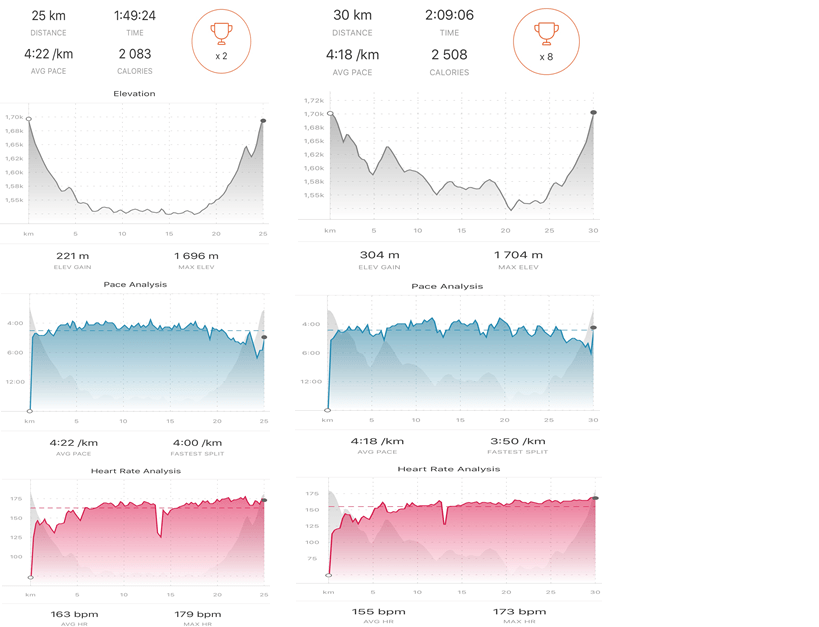
Below are two running sessions I did with a sub 6hr Comrades runner in the beginning of the year while he was building for the big day.

The Strava segments below are quite straight forward. Both are controlled runs. The one on the left was a 25km run 221m of elevation at an average pace of 4:22. The average heart rate for this run was 163 BPM (Beats Per Minute) as shown in the heart rate chart below.  On the right side is a longer route of 30km with much more elevation and you will notice the pace for the 30km run was faster than that of the 25km run. However, the interesting part is that the slower paced shorter run with less elevation had a much higher average heart rate.  A difference of 8 BPM which is quite significant. Someone said its because you were fitter in the second run, but not, as these were a week apart and fitness doesn’t change that rapidly. The main reason is that the average temperature in the first run was hotter than in the second run. Temperature increase equates to higher heart rate, higher perceived effort which spins into the slower pace.


The above is purely a graphical representation of how at Comrades Marathon if you did feel like you were in control of the pace due to effort you might have gone slightly faster under cooler conditions without realising it as it was cooler on the day.  If this is the case and your muscles were not conditioned for the faster pace over time I can with absolute certainty say the muscles were going to fatigue earlier on and your race would be a sufferfest from that point on. You need to understand how temperature affects the body under stress and adjust pace accordingly this could be one reason for having a bad day out.

Pre-Race Fuelling
I have witnessed the most horrific fuelling strategies on race day and seen how sick people get on the course. The interesting thing is it all starts with the pre-race meal on the morning of the race. Firstly, the meal needs to be tried and tested and many runners suddenly do a switch on race day which can lead to major discomfort later.

Whether a low carb or high carb eater I always advocate a meal of around 1-4grams of carbohydrate intake per a kilogram of body weight around 1-4hrs before an event.  The lower end if you are a lower carb eater and only if you have tried and tested it you can go to the upper end but a higher intake closer to the 4hr mark and lower intake closer to the event. Secondly, we are talking very easily digestible carbohydrates, low in fibre so as not to irritate the bowels. I advocate protein intake as well for long events and would look at a 3:1 or 4:1 carb to protein intake and if you do consume protein then easily digestible lean protein (low to no fat) nothing heavy that would sit and create discomfort. I am not a fan of high fat intake prior to an event, it takes a long time to break down and it can lead to the onset of GI (gastric intestinal) distress during the race. At 2am each year I join the masses in the hotel breakfast room and watch with curious intent at what each person is consuming pre-race. I don’t look at it emotionally I look at it from a performance perspective. Very often I can see by what an athlete consumes whether they will have a bad day or good day out as that can be the first mistake they make on race morning. If you had a rough stomach day think back to what you ate on race morning. It might have been something simple like oats which you might have had before but the question then is which oats did they use? How did the cook it? In water or milk? If milk which milk low or high fat? How long before was it prepared? All these factors can influence a 90km trot. Best is to be prepared.

Race Fuelling
An ultra-marathon is tough. It’s tough on the body and tough on the mind. It’s a long journey which requires optimal fuelling. On Comrades day pace and preference will determine fuel intake. The elite athletes I work with will have liquid feeds on route as their airways need to remain open at all times to allow maximum oxygen uptake to support their efforts. The slower back packers can easily afford to chew or bite on food solids and often walks through water tables allow for this.

The two biggest mistakes in fuelling on race day are over fuelling and nutrient timing.  Let’s look at over fuelling first. Taking in too many carbohydrates during an endurance event can certainly lead to digestive discomfort, but it can also lead to nausea and dizziness. Finally cramping can be triggered by a glucose overload in that it can cause an overly hypertonic environment in the digestive tracts and mitigate optimal fluid uptake from taking place leaving the muscles depleted and in a very unhappy state. How many grams of carbohydrates did you consume per an hour on race day? I feel anything between 30-60grams is more than enough for a runner. Some athletes do go higher and anything on the high end will have to be tested way before race day to see how the digestive system copes with the volume of carbs consumed. It’s not about how many carbs you stick in your mouth but more about what the body is capable of absorbing and processing for use.  How do you prevent over consumption and still maintain a steady flow of energy and remain comfortable? It’s quite simple it’s about nutrient timing and it’s called drip feeding. Split the feeds into smaller more frequent meals over time to allow for the already stressed digestive system to absorb and use the intake without causing any havoc. Over and above that you will be shortening the peaks and troughs of the blood sugar rise and fall, and this will allow for a more balanced energy effect. So, when consuming a gel its better to go with a third to half of a gel every 20-30min as opposed to one gel every 45 minutes. The next statement I am going to make might upset a few runners, but a gel is not a suitable feed for a slow runner over a long period of time. We hardly feed the elite athletes gels on route, they prefer a more balanced approach to fuelling and try to combine the hydration and fuelling together by using various prepared solutions on route which start off more hypertonic in nature when cold and then slowly evolve to isotonic and hypotonic solutions when the temperatures climb later in the event. Options on route are a must as with weather conditions you never know what to expect over time. Comrades marathon isn’t primarily a glycogen fuelled effort but more of a fat tank fuelled effort and so I advocate fuelling accordingly to maximize fat oxidation. If you are not sure about the human fuel tanks used during sports performance, then check out my video on Getting into the Zone where I explain how they work.

Protein Intake
Did you take in protein on the Comrades route? I can promise you if you didn’t then the fatigue would have set in a earlier than an athlete that did take it in. In fact, all the front runner elite athletes we fed on route were mainly fuelled with a protein shake I made up specifically for them, including Bongmusa Mthembu the winner on the day. I used 32Gi Recover 2 scoops to 200ml of fluid with 95mg of caffeine in the form of TrueStart Coffee mixed into it. Why did I do that? Simple I want the runners to get in around 5-6grams of protein minimum per an hour with the carbohydrates in the mix. (check out my video on 32Gi Recover discussing the need for it during an event) Nutrient delivery is optimal, and the intake of protein can lead to the delayed onset of muscle fatigue by delaying muscle protein catabolization as well as keep any hunger at bay. On average an elite athletes will take in around 6-12grams of protein per an hour and around 20 – 50grams of carbohydrates and anywhere from 95-120mg of caffeine. What is interesting about this number is it’s not high at all and yet it’s perfectly suited to the winning performances we see every year. Most slower runners consume way more. The slower amateur athletes I did advise to consume protein on route at least at the 30-40km mark and then 50-60km mark all gave very positive feedback as to how it was a game changer for them on the day and how much they enjoyed the feeling of it. It certainly made a difference on the day.

Hydration
Hydration to me is the more crucial aspect of Comrades Marathon in that you have sufficient fuel in your natural fuel tanks in the form of glycogen and fat to get you to the finish line and hydration will play an even more important role on the day. It is not possible to replenish all the fluid lost in the form of sweat during exercise, but we aim for an 80% replenishment. To do this water consumed on its own will not achieve this as it has a slower absorption rate than a mineral or isotonic carbohydrate drink. When I feed elite athletes, I do not allow pure water consumption unless it’s with some sort of a carbohydrate or mineral rich product which will help pull the fluid out of the digestive tracts into the system. I prefer a hypotonic drink as a means of hydration as it is designed to maximize fluid absorption. Drinking water on its own will sit in the stomach and take its time to get out if there is nothing assisting it. This can lead not just to stomach discomfort and a washing machine effect with fluid sloshing around inside, but it can also place strain on the kidneys and could ultimately be a trigger of hyponatremia (overhydration) which can lead to illness and in severe cases death. In our case we use 32Gi Hydrate for seconding which is a pure electrolyte solution with a decent sodium content to ensure rapid fluid absorption. (Check out my blog on Hydration to get more in-depth understanding)

Caffeine
Did you take in caffeine on race day? It can be in any form and many forget that even coke contains caffeine. So the low down on caffeine is such. Firstly it needs to be tried and tested, it is acidic and if you don’t tolerate it well it can cause digestive issues. Secondly caffeine is one of those stimulants that once consumed will metabolize over an approximate time of 60 minutes meaning that once you get the rise you will get the fall. If you start taking it in you need to keep taking it in prior to the 60 minute life, otherwise you will hit a downer. When taking in caffeine understand once you start you need to keep going. Some runners will take much later in the race when they need it and there are those that take all the way through. If you did consume caffeine early on but did not continue with it you might have felt the dreaded crash.

Every year on Comrades route nausea and cramps takes its toll on the masses of runners that haven’t practised proper fuelling strategies and have just read the packaging directions on a product. The problem is the packaging on a product does not know you are running a 90km run over so many hours and so it is of prime importance to ensure you have planned, tried and tested your fuelling strategies under various conditions before you get to race day to ensure you don’t land up in the pitfalls of the many that do.

If Comrades was a good day out for you that’s great and maybe you had everything properly planned or you did fall victim to some of the issues on race day and managed to overcome them. Possibly you can do much better next year with a better prepared and properly planned strategy to tackle the up run. If you were one of those that had a miserable day out I can pretty much bet, you were under prepared from a training and or nutrition perspective and this is your opportunity to think very carefully about how you can better tackle an ultra-event the next time you do.

In the meantime well done to all the finishers, recover well and yes this does require proper nutrition as well 😉. Get proper rest and begin an active recovery program when ready and make sure you plan better for next time.

All the best

M

Mark Wolff is a certified sports nutritionist and an endurance nutrition and physiology expert with over 20 years experience. An endurance multi-sport athlete with a triathlon, mountain biking and weight lifting background, he works extensively with professional and amateur athletes in a variety of sports disciplines as well as those just wanting to change their lifestyles. He firmly believes that a person can only reach their full potential when their health and nutrition is down packed. Mark’s focus on nutrition and physiology is not just on training and racing, but he places major emphasis on recovery, immune system health, emotional stability, stress management and performance. Mark is co-founder of 32Gi a sports nutrition company, focused mainly on health and endurance nutrition.


Categories
Nutrition Performance Training

COMRADES MARATHON – THE FINAL DAYS – The 48hrs before & Race Day Fuelling

In the previous blog we discussed race week nutrition and hydration. In this final blog I am going to focus on the 48hrs up until race day including race day itself. If you missed the previous blogs then just click here to access

For me personally the two days leading into any race requires planning in order to ensure I limit any stresses and can completely relax and focus on the big day.  I have a plan for sleeping, eating, race kit & preparation so that the last days before the race I can completely relax.

As mentioned in the previous blogs my menu for the days leading up to the event is completely planned. Wherever I have travelled in the world to race, I know exactly what to eat, how to hydrate and remove all the pressures associated with last minute race planning because its already been done. If you fail to prepare then you can prepare to fail. No need to cram everything into the last minute and make mistakes.

48 HOURS BEFORE RACE DAY
The 48hrs prior to your race try to give us much focus to sleep, hydration and nutrition as possible. Keep the feet up nicely and allow them the much needed rest before tackling the gruelling event. If you do go to expo in the 48hrs before the event then please try not to spend too much time there. I stand at expo’s a lot and watching runners shopping for hours on end is just madness so close to a race. Limit your time on the legs or you will definitely land up fatiguing them. Expos are also famous for unhealthy fast food and beer drinking. Don’t get caught up in this. The amount of food passing through the kitchens each hour and the conditions in which they are managed is less than stellar before a major event. Take with water to the expo so when you are queueing you are hydrating as you never know how long you might land up being in the line for an potentially being exposed to the sun. As for the beer, its dehydrating you for sure and being in a dehydrated state before an event is not the place you want to be. Take with some snacks as well so that you can keep your stores nicely topped up at race registration.

Eating or drinking something that doesn’t sit well with the body can cause digestive issues, illness and dehydration and it can lead to a really bad day out. For example if you are lactose intolerant do not compromise and consume any dairy steer clear of it. In many athletes red meat sits heavily in the stomach, so if this is the case with you avoid heavy proteins and rather eat lean proteins or plant based proteins. Finally do not try any new foods before the event stick to what you know and what agrees with you. Do not overdo it with stimulants especially caffeinated drinks such as coffee as they do have a diuretic effect and can also lead to sleep disturbance. You need to get a few good night’s sleep before the race, so you don’t want to impact your sleep by taking any stimulants which would impact it at night.

Some athletes deplete carbohydrate stores closer to a race and then slowly build up that carbohydrate intake to maximize their glycogen stores. Don’t try this if you’ve never tried it before. There is no reason to overeat carbohydrates in those hours before an event because your glycogen stores will be topped up with reduced volume in training and it’s not going to make a major difference on race day. Overdoing it will just lead to weight gain and discomfort.

24 HOURS BEFORE RACE DAY
Nerves are beginning the months of preparation are now coming to the big test. Friday night is the night you want to get a really good nights sleep and if you can extend it the following morning that’s absolutely fine. You wont be sleeping much the night before so get in as much sleep as you can the day before.
Plan to eat nice consistent meals the day prior to the event. You can up the carbohydrate intake slightly but keep the eating controlled and manageable do not overeat. Hydrate consistently and try to avoid consuming anything that has a diuretic effect.

Many athletes tend to eat a large meal the night before the race in order to really top up glycogen stores. I feel this is not necessary at all and can in actual fact be more damaging. Consuming a large meal the night before race day will set off some digestive discomfort and will impact your ability to sleep properly. Sleep is more important than overloading the digestive system. As for hydration do not drink a lot before sleep that night. Hydration should be done through the day. Drinking too much before you go to bed is just going to impact your sleep even more by forcing you to run up and down to the bathroom. If you want a slightly larger carbohydrate meal before the event then do it at lunch time, but keep the night time meal nice and small. I also would not advocate eating out the night before. I have seen many athletes eat hotel room service or take outs only to succumb to the ills of a bad stomach or nausea the next day. Plan your meal properly.

RACE DAY

THE PRE-RACE MEAL
A lot of athletes tend to not eat before a big race, but it is the most crucial meal of the day.

What you take in on the morning of race day is going to play a very important role in fuelling you during your race. I suggest eating a meal that will provide you stability and give you the energy requirements that you need during the event.

In looking for the most appropriate pre-race meal the food firstly needs to be something that you are used to and have eaten previously. Do not try anything new on race day. Generally, I advocate a slightly higher carbohydrate meal, unless you are a high fat low carb eater (banter). Depending on the kind of diet that you follow you need to try and keep it simple and healthy. The best time to eat would be at least a minimum of two hours before the event start so that you have enough time to allow the food to digest and the stomach to settle. However many get up very early to drive far to the start and in this case I would look at an additional 100 Calories for every additional hour you eating before the event.

Depending on your weight, a meal between 200-400 calories (depending on weight and time consumed) should be more than sufficient from an energy perspective at that time of the morning. If you are too close to the start time, then reduce the calorie intake accordingly to ensure that the digestive system maintains a level of comfort in the early part of the race.

If you eat breakfast early and its a smaller manageable meal then you can always take an easily digestible food on route with you to the start such as a banana and eat a little more before the event.

DO NOT skip your pre-race meal it is the most important meal of the day. I often get asked what good meal examples would be as a pre-race meal and this is how I would go about planning it.


  1. Do not eat what doesn’t agree with you and what has not been tested previously.
  2. Start with the carbohydrate content and keep it simple and easily digestible.
  3. Ensure the carbohydrate selected doesn’t spike your blood sugar but provides some form of stability.
  4. Keep the fibre as low as possible (high fibre can irritate the bowels)
  5. Protein can assist in delaying onset of muscle fatigue in long endurance events and I would suggest adding in a little to your pre-race meal.
  6. Fat can also be added but I would opt for the type of fat that provides more easily accessible energy, and, in this case, medium chain triglyceride’s are best.


Examples of a pre-race meals could be a gluten free rolled oats, nut butter and some banana or berries. You could eat some banana on low fibre bread or toast, sweet potato, rice or quinoa pudding or oatmeal, spelt or sorghum pancakes. Eggs on toast with a little avocado is also fine, it really depends on the kind of person you are, what kind of diet you follow and what you are used to consuming pre-exercise If following a low carb lifestyle, you can opt for a higher fat meal (the larger portion being medium chain fats) however, I would still advocate a stability carbohydrate before and keep the protein intake small.

Remember, what you eat before the race is going to help fuel you during the race and you need to start your ultra-distance event with topped-up fuel tanks.

THE CAFFEINE BENEFIT

Caffeine is a stimulant and it is beneficial in endurance sport. It has been shown to aid performance when consumed correctly. Caffeine provides mental focus and in any endurance sport this plays a crucial role in sports performance. It is recommended to consume 1-3mg/kg of bodyweight around 2-4hrs before an event. Coffee is not a good measure of caffeine unless it’s a coffee like TrueStart Coffee where you know exactly how much caffeine there is per a serving. Caffeine intake must be measured. It should also have been tried and tested in training to understand how the body responds.

When heading off to the event, make sure you do hydrate sufficiently, but do not over-hydrate because at that time of the morning it’s very cool and the last thing you want to do when the event starts is have that heavy stomach feeling and overloaded bladder forcing you to run to the toilet.

RACE FUELLING

Race day fuelling needs to be properly planned and you should have practised this in your training. If you haven’t, you have completely fallen short of preparing properly for the event because nutrition is a make or break.

You cannot just rely on the nutrition that’s on the course if you haven’t tried and tested it. The best way to fuel in an endurance event, specifically a Comrades Marathon is to make sure you separate your hydration and your energy requirements. Think about hydration in terms of what’s going to keep the body hydrated not about energy. Hydration has been spoken about extensively in the past and if you are not sure you can read my blog Simply Hydrate to get a more in-depth understanding.

As for energy requirements you need to know how much you’re going to be consuming in the form of grams of carbohydrates per an hour during the event to give you the optimal fuel to perform. A large portion of your energy requirements will come from your internal fuel tanks being glycogen and fat, however by taking in the appropriate volume and type of fuel you can assist glycogen sparing and keep your primary fuel tanks lasting longer. To get an understanding of the internal fuel tanks and usage check out my video explanation Get In the Zone.

Most athletes will consume their energy in the form of carbohydrates and you should have by now practised the volume intake of carbohydrates you require per an hour to keep you sustained through the event. Runners have a more sensitive digestive system due to it being a higher impact sport than cycling so I do advocate smaller feeds, more frequently, as opposed to bigger feeds spaced further apart. The reason for this is twofold firstly the digestive system can cope better with smaller amounts of food at a time and more easily utilise and absorb it as opposed to dealing with a very large amount of fuel at once. Secondly it provides more energy balance. I call this the ‘drip feeding’ method, and I find it works very well for most athletes. Remember Comrades Marathon is primarily a fat tank fuelled event, its pace controlled so more oxygen to the system will allow for a better ability to burn fat for fuel. If you over consume carbohydrates you will give too much rise to insulin levels, mitigating fat burn and landing up on a roller coast ride eventually leading to potential nausea and even cramping if there is a glucose overload.

Fuelling every 20-30 minutes as opposed to every 45 minutes to an hour would be a lot easier on the digestive system and it would allow you to balance that energy system out a lot better. In other words, clock feeding and making sure you do take something every 20-30 minutes. This will ensure  better insulin response as well as less gastrointestinal distress and more manageable absorption in the digestive tracts.

Some runners can get away with as little as 20-30g of carbohydrates per an hour and some need to take a lot more, but anywhere between the 20g-60g mark would be fine based on individual requirements. Remember to stick to what you have done during training. It is not about the amount of carbohydrates that you’re taking in, it is about what your body is capable of absorbing and utilising. Anybody can consume a large amount of fuel, but it does not mean that the body is going to utilise and absorb it and this can lead to severe digestive issues. If you take in too many carbs overdoing it with the sugar and glucose, it can lead to muscle cramping mainly due to poor fluid absorption. It can also lead to dizziness and nausea and it’s the last place you want to be during a race.  My advice is to take in the least amount of fuel to achieve the greatest possible result.

Caffeine during the Race

Caffeine during the race can play a benefit as well. Caffeine does metabolize fully over a period of around 60minutes, so my advice is to have measured doses throughout the event once you do start consuming.  I recommend at least once an hour some athletes consume every 30 minutes, but this is something that needs to be tried and tested in training to see what the optimal dose is for you during exercise. Caffeine has shown to improve performance especially in the form of mental focus and in a long endurance event the mind needs to be focussed and strong.

Protein during the Race

An absolute must for Comrades Marathon is protein consumption on route. If you’re going into an ultra-distance event and it’s going to be a lot longer than 4-5 hours, you should incorporate protein consumption on route, just to help act as a buffer and assist in delaying the onset of muscle fatigue. It also helps satiate you, in other words, it gets rid of the hunger pains and it does break up that intake of glucose. I would highly recommend a 1:3 protein to carbohydrate ratio which has been shown to maximize the delayed onset of muscle fatigue. If you want to know more I have recently done a video on a protein we fuel our gold medallists and elite athletes on route and it works extremely well.  Click here for information on which protein to consume.

Please make sure that you are prepared from a race nutrition perspective. If you’re not prepared, you better start thinking about it very soon and make sure you’ve got some sort of plan for the big day. On the day, stick to your plan, don’t deviate and you will get to the finish line feeling a lot happier and a lot more comfortable. DO NOT try anything different or new on race day.

I wish you all the best of luck, may you have a great race.


all the best

M


Mark Wolff is a certified sports nutritionist and an endurance nutrition and physiology expert with over 20 years experience. An endurance multi-sport athlete with a triathlon, mountain biking and weight lifting background, he works extensively with professional and amateur athletes in a variety of sports disciplines as well as those just wanting to change their lifestyles. He firmly believes that a person can only reach their full potential when their health and nutrition is down packed. Mark’s focus on nutrition and physiology is not just on training and racing, but he places major emphasis on recovery, immune system health, emotional stability, stress management and performance. Mark is co-founder of 32Gi, a sports nutrition company, focused mainly on health and endurance nutrition.

Categories
Nutrition Performance

COMRADES MARATHON – THE FINAL DAYS – Race Week Eating / Carbo-Loading Debate

So in the previous blog on preparation for Comrades Marathon (if you haven’t read it just click here) I touched on basic guidelines to adhere to around the taper weeks.

In this blog I am going to focus on actual race week which is the week leading up to race day. Its the one week that if managed correctly it can make a big difference on race day.
We already discussed the positive benefits of sleep in leading up to race day and its something that I will briefly re-emphasize on doing all the way up until race day. However in this blog the focus will revolve more around nutrition.

Race week is one where stress levels are higher and sometimes forgotten and last minute preparations can cause a few panic stations among the masses leading to the neglect of areas that are actually important.

NUTRITION
Eating well in race week is important not just from a recovery and energy perspective, but also for health. Any foods you consume which you are intolerant to have the potential to ruin your race. Over the years I have seen many athletes succumbing to stomach bugs in race week, which no only weaken you but can also lead to dehydration and severely compromised gut bacteria. If this does happen, your race if you actually manage to get to the start line will start off on the back foot. Its the last thing you need. Focus on foods that you know sit well with you and do not compromise. Do not try anything new. Avoid soups and sauces or anything that you cannot completely identify the ingredients of and make sure you can know exactly what you are eating and play it safe. You have spent months training for Comrades the last thing you want to do is ruin it all in a day.

CARBO-LOADING
As far as meals go keep them smaller and frequent and ensure a nice balance of healthy carbohydrates, fats and lean proteins. Lets take a look at carbo-loading which can be a highly debatable subject.
I often hear athletes speaking about carbo-loading without really understanding what the purpose is or how it is achieved. The term carbo-loading is widely used and its purpose is to top up glycogen stores prior to an event in order to maximize muscle and liver glycogen which of course is the quickest source of easily accessible fuel during exercise.

The human body has two primary fuel tanks glycogen and fat. Glycogen you can compare to rocket fuel, it is the main source of fuel when the body is oxygen deprived and is quickly converted to aid the production of ATP (Adenosine triphospate) which of course is what fires our muscles for motion. Our glycogen stores are capable of approximately 2000 Calories of fuel storage. As you can see the glycogen fuel tank is limited in that it cannot last very long and over time will deplete. The other primary fuel tank fat is much larger in that it can harness around 40 000 Calories of fuel. Fat though takes much longer to be converted into ATP molecules and a nice portion of oxygen over time is required to do this. This is where the debate comes in. In shorter higher intensity events glycogen will be a primary fuel source and so the larger the tank and the more it can be spared through the consumption of carbohydrates the longer it will support the effort. Click here to check out my animated video explanation on the fuel tanks to get a better understanding, of how they work.

However we are talking about Comrades Marathon and this is not a race performed at a very high intensity. Its a pace controlled event meaning that breathing should be regulated and more oxygen should be made available to the system. Controlled pacing allows the fat fuel tank to become highly accessible and with a higher rate of fat oxidation during exercise a higher percentage of glycogen will be spared.

Exercise will of course use a percentage of both glycogen and fat however pace will determine which of the two is most used. The question itself of is carbo-loading necessary is now begging to be answered. My answer in short is I do not feel its a major necessity. Why? Because you are in a week where training is at its lowest and by eating healthily constructed meals your glycogen stores will top up nicely over time. If they are topped up to a fraction higher than usual will it make a huge difference over a 90km run? For the average person highly unlikely. If its an elite athlete an percentage gains are the difference between win or loss that is an entirely different debate.
A runner has a higher risk of gaining weight by over ingesting carbohydrates prior to an event and that will just lead to a bit of a tougher day out.
Glycogen does have weight and for each gram of glycogen you would expect to see it bound to 3-4grams of water. So glycogen topping up can certainly lead to higher water retention and a higher weight. If its purely glycogen weight that is not a terrible thing but if its more than just glycogen weight you can land up in a spot of trouble.

Now its one thing saying you are carbo-loading but the question I will ask next is have you done this repeatedly in training ? Do you know exactly what to do and how to do it? Most athletes don’t.

There are 3 types of carbohydrate loading regimes which most athletes utilize. The classic, modified and 1 day regime.

Classic Regime

The classic regime is a complete carbohydrate depletion from 6 – 4 days out from the event with high intensity training to drop the glycogen stores and then reintroducing a high carbohydrate regime to replenish and top them up. Its quite a dangerous regime in that unless you know the timing intimately well you might not top them up in time and secondly doing intensity work the few days before leading up to the event with the lower carbohydrate intake can lead to fatigue.

Modified Regime

A more popular carbohydrate loading regime is the modified regime. Exhaustive training is done 6 days out from the event but along with the introduction of a moderate carbohydrate diet and then gradually building to a higher carbohydrate diet closer to the event is a safer play. However unless you have done this before I would not recommend it.

One Day Regime

In this carbo-loading regime no exhaustive training takes place and there is an increase in carbohydrates a few days out with a large carbohydrate intake the day before the event. Again this needs to be tried and tested.

If you havent experimented with the above before then my suggestions for macronutrient eating during the week is simple.

1. Overall calorie intake MUST drop in line with reduced training volume. Overeating causes weight gain.
2. Ensure you are eating an adequate amount of protein daily prior to the event. I would suggest 1.2 – 1.4 grams/kg of bodyweight and split 3 hourly. It of course also ensures you maintain nitrogen balance.
3. Slightly increase your  carbohydrate intake however in the form of low insulin spiking carbohydrates (Low GI).
Remember the GI index is measured to a 50 gram carbohydrate serving so if you consume in excess of this the GI index does not apply and you would need to look at the Gylcemic Load (GL) in order to ensure you do not trigger an excessive rise in blood sugar post consumption.

If you want to increase the carbohydrate meal the day prior to the event I would suggest eating a slightly higher carbohydrate meal for lunch the day before but keep the night time meal smaller for the sole purpose of being able to get a better nights sleep and avoiding digestive discomfort.

PRE-RACE NERVES AND DIGESTIVE IMPACT
Pre-race nerves can cause havoc with the digestive system and signs of
– Nausea,
– Diarrhea,
– Stomach Cramps and
– Appetite Reduction can easily occur.

There are a few things you can do to deal with this.
Keep Fibre Intake Low
Avoid high fibre foods such as bran, high fibre-breads, cereals and dried fruit rather go with low fibre foods. An example would be white bread as opposed to brown seed or whole wheat bread loaf.
Avoid heavy cruciferous vegetables which can cause flatulence and stomach discomfort

Liquid Food
If you are battling with your appetite in race week then opt for more liquid type meals which can help when your appetite is suppressed. Smoothies, porridges, cereals and soft dense foods are perfectly fine, just ensure you understand the composition.

Acid vs Alkaline
Food type can of course play an important role on digestive acids and trigger stomach issues. The best thing you can do is stick to more alkaline type foods in race week to lower acid levels and keep the stomach happy as well as assisting in the reduction of any inflammation in the body. Caffeine is acidic and can lead to irritability. If you do battle in race week with irritable bowels then keep caffeine to a minimum or even eliminate it.

HYDRATION
Hydration is without a doubt a crucial part of race week. Proper hydration is key to arriving at race day completely hydrated and ready to tackle the event. Remember every day during race week you are losing fluid in the form of sweat, urine and faeces and its important to keep topped up. I advocate consuming a hypotonic drink during race week to maximize hydration and this can be consumed daily to ensure the pull through rate is efficient. To understand more about hydration and hypotonic drinks click here
Alcohol in race week is an absolute no! It pulls fluid from the system it dehydrates you and it is completely counteractive to what you are trying to achieve. Save the alcohol for after the event please.

I hope this helps you mentally prepare for the week ahead. You now have time to plan your nutrition and hydration for race week and if you follow these simple guidelines you cannot go wrong.


all the best

M

Mark Wolff is a certified sports nutritionist and an endurance nutrition and physiology expert with over 20 years experience. An endurance multi-sport athlete with a triathlon, mountain biking and weight lifting background, he works extensively with professional and amateur athletes in a variety of sports disciplines as well as those just wanting to change their lifestyles. He firmly believes that a person can only reach their full potential when their health and nutrition is down packed. Mark’s focus on nutrition and physiology is not just on training and racing, but he places major emphasis on recovery, immune system health, emotional stability, stress management and performance. Mark is co-founder of 32Gi, a sports nutrition company, focused mainly on health and endurance nutrition.

Categories
Health Nutrition

HEALTH BEFORE STUPIDITY

A walk around my local health store is quite an experience. A huge abundance of vitamins, minerals and every other supplement known to man. Not only are they easily accessible but they make claims which the average individual has no idea how to interpret. Under a variety of circumstances a person especially an athlete will make an emotional buying decision on a product advocating a cure from illness such as the common cold to promises of sports performance gains on a wide range of levels.

Little does the health store tourist understand that his little purchase spree might not be of any benefit but in actual fact harmful to his or her health depending on a number of factors which were never taken into account.

As a sports nutritionist I would never advocate a mineral or vitamin without the facts at hand and that is without a doubt a snap shot of an individuals health as a starting point. I would want to know what kind of lifestyle the individual has, what kind of an athlete he or she is and the daily demands which may impact their health status on a number of levels from lack of sleep to many hours of travelling or desk bound for most of the day. Then comes the crucial question which is, what does the individual eat and drink throughout the day and the meal timing that goes with it.

How can anyone expect to walk into a health store buy a product off the shelf and expect an amazing turn around time in health or performance. As the actress Sher once stated “If fitness came in a bottle, everyone would have a great body” . So, I am sorry to burst your bubble but there are NO quick fixes in life. It takes hard work and effort, and if you gained 20kg’s over a 2 year period it doesn’t mean it will come off in 2 months it took time to put it there it will take time to take it off.

Lets go back to the point of my discussion which is really the topic of supplementation. I often get asked about multivitamins and mineral consumption especially what has the best benefit for an athlete. Its like the oil industry additives can make the difference between jet fuel and a lubricant.
In truth I am not a fan of anything without being able to answer the questions I posed earlier on. I will always deep dive into a persons health and lifestyle to make an educated decision, but when I am not convinced I will dive even deeper.

I am going to take a step back here.
As a human being you might not have been living the most stellar lifestyle. Nutrition might be average, sleep not the best and yet each day you will attempt to add some physical activity to your daily routine.
I often use the analogy of comparing a human being to a motor vehicle. A vehicle has an outer shell, could be a Lamborghini, VW Beetle or a Mini-Van. The vehicle has an engine and the type of vehicle it is will determine the engines ability to perform. It could be a high performance vehicle or just a slow comfortable drive. If you are going on a long journey in your vehicle for a few days you will make sure that vehicle is in excellent condition. Tire treads perfect, windscreen wipers working, fuel topped up, oil checked car sent for its annual or bi-annual service to make sure you get to your destination safely. The minute you put your foot on that accelerator and place the vehicle under stress you need to be sure its going to withstand it and get you to where you are going.

Now the human body can also be compared to a vehicle. It has an outer shell, whether lean or plump and it has an incredible engine made up of major organs, a musculoskeletal  system for motion and of course a fuel tank to propel it. As a human being you have chosen a journey as well. It could be the finish line of a marathon, half marathon or an ultra distance event. Believe me when I say that the day you start training for this event is the day your own engine begins to be placed under stress. If your own engine is not in good working order you are just asking for trouble. When I ask athletes how do they know their engines are in good working order they just say they know. Its the most ridiculous answer I have ever heard. Its impossible to know what is going on inside your body without actually having a very clear picture.

Most of you will have sent your cars for services in the last year but I can bet on it that you have not even bothered to service your own vehicles. Now you are just about to place it or are already placing it under major stress and you have no idea if you are going to burst a pipe and trigger a major illness, injury or at worst case heart failure.

When last were you at a medical check up and what were your results? I find it such an irony that people in general value their own motor vehicles more than they do their own body’s. Car washes are loaded to keep the vehicles nice, shiny and new. Petrol and oil preferences are always debated especially to give your motor vehicle the best fuel burn rates and your car is treated like your baby. Your body is just abused. It is time to wake up. If your body fails you wont even need a motor vehicle.

Get your own vehicle serviced and make sure its done properly. Bloods don’t lie. If there are any vitamin or mineral deficiencies they can be picked up in blood tests. If there are health issues they will be detected, and only then do you decide with professional advice how to treat if needed. If supplementation is needed that will purely be based on the results of your testing to make sure its the correct decision. I cannot stress this enough, but taking a supplement, vitamin or mineral for the sake of taking it without understanding why and if its required is in simple terms stupid. The highly advertised vitamin drips, and health store aisles loaded with supplements should be approached with absolute caution and one needs to understand exactly what they are treating and how. Consult an expert if you are not sure, but do not succumb to the masses who spend money on damaging their health as opposed to fortifying it.

Know your health status, understand your body’s requirements intimately and give it the proper fuel it deserves.


Mark Wolff is an endurance, sports nutrition and physiology expert with over 20 years experience. An endurance multisport athlete with a triathlon, mountain biking and weight lifting background, he works extensively with professional and amateur athletes in a variety of sports disciplines as well as those just wanting to change their lifestyles. He firmly believes that a person can only reach their full potential when their health and nutrition is down packed. Mark’s focus on nutrition and physiology is not just on training and racing, but he places major emphasis on recovery, immune system health, emotional stability, stress management and performance. Mark is co-founder of 32Gi, a sports nutrition company, focused mainly on health and endurance nutrition. He is a certified sports nutrition expert as well as a marathon, track, triathlon and cycling coach. He spends most of his time guiding athletes with a very holistic approach to blending training and nutrition for performance and health

Categories
Nutrition Performance Recovery Training

TWO OCEANS MARATHON – ARE YOU ON TARGET – TAPER WEEK NUTRITION

In this second part of the Two Oceans nutrition series we discuss what to do around nutrition during the taper weeks.

Below is a good read to understand what you should be thinking about around Taper Week Nutrition and you can also listen to the podcast I have pulled in below which I did with David Katz.

The Trick to Nutritional Tapering

Its important to understand that during the taper period your volume of training is reduced significantly. Reduced volume means that you’re requiring less fuel during the day than what you were used to previously.

During peak weeks you were burning off a lot more calories and calorie consumption requirements were a lot higher in order to be able to try and replenish that deficit to keep your energy system up, and obviously to keep your immune system strong as well as ensuring proper recovery between workouts.

What happens during the taper weeks is that the volume drops and there’s a lot of sharpening. It does not mean you’re going to stop training, you obviously carry on training and there could be quite a bit of pace as well, but obviously shorter periods of time to keep the legs sharp and the body recovering and building to peak on race day.  Lowered volume training equals lowered calorie intake as your physical activity level drops.

Keep the Immune System Strong

There are four main areas that I like to suggest all athletes focus on during the taper and number one is immune system strength. You  need to get to your event in a very healthy state. You do not want to fall ill before that. We know that when an athlete hits peak training, generally their immune system is quite lowered, the body hits fatigue, and there is a very high susceptibility to infection.

Obviously this will be more prevalent when you’re exposed to children and people close to work who are harboring illness. I have seen some serious athletes running around with face masks close to the event because they fear getting sick.

How do you keep the immune system strong?

Simple keep inflammatory foods out of the diet, focus more an alkaline diet to keep inflammation at bay. Focus on clean foods forget take outs and processed foods you want to fortify the body not weaken it. Rest, Rest, Rest. Sleep is crucial don’t sacrifice it and due to shorter training sessions, push them out later so that you can ensure you get through all your sleep cycles by waking up slightly later than normal. Hydrate constantly and ensure you are consuming fluid in the form of healthy water and herbal teas. Keep stimulants such as coffee down to a bare minimum as it also raises acidity in the body which can equate to a higher risk of getting ill. Do not skip meals keep the portions small, healthy, nutrient dense and more frequent.
Do not think multivitamins and vitamin drips are the answer, as the body responds to this in a way which could completely weaken the energy system by playing some havoc with the bloods. As a matter of interest research has shown Vitamin C as an example of anti-oxidant supplementation has been shown to hamper endurance. In this case over consuming it is just not a good idea, best is to take it when you need it and not daily if your training is fairly heavy. Vitamins and minerals are there for deficiencies take it only when needed.

Importance of Weight Management

Number two is weight management. Obviously as the volume of training decreases, the amount of calories will need to fall in line with that. You do not want to gain weight for your race. The reason being, is that if you do gain weight by the time you race, you are going to suffer. You’re used to training at a particular weight, you want to race at that same weight. You really need to hone in on your diet and make sure you keep it in check.

The only way to do this is to obviously focus on eating cleanly, don’t eat out, reduce and cut sugar intake. The other thing is, you can also reduce is your protein intake slightly and carbohydrate intake in the week prior, and you can gradually build the carbohydrate intake slightly a few days before to maximize glycogen stores. Do not try and cycle carbohydrate depletion and an increase if you have not experimented with it before. Remember whatever you do your macro-nutrients need to be in line with calorie requirements. Do not over do it as excessive eating will lead to weight gain and this is seen in abundance with athletes when they do carbohydrate loading for which there is no major need. Keep your nutrition in check and do not let it slip in the week leading up to the race.

How to Maximize Muscle Recovery

Muscle recovery is very important during the tapering period, you need to make sure that you’re getting strength gains and you’re not fatiguing yourself for the big day. This is the time to rest, recover and build and get to the race in peak shape.

Remember, training breaks you down, proper rest and recovery builds you up and makes you stronger. This has a very large dependency on nutrition. Make sure that you eat for recovery.

How do you do that?
Ensure you get the right amount of protein in on a daily basis. If you are not sure how much you should be consuming check out my blog on protein (Protein Myths) . Eat a lot of leafy, green vegetables, this can help increase folate levels and ultimately lead to more rich red blood cells which increases your oxygen levels in the blood and this can have a very positive impact in endurance and sports performance. Aim for healthy fruit to improve your immune system and energy levels. Cut all the nonsense and eat to strengthen the body for the big day.

Be Race Fuel Prepared

One of the other very important factors during taper is to make sure that in your mind you have your race fuel preparation ready. The way you prepare your body from a nutrition perspective in the weeks and days leading up to an event will either make or break your fuelling strategy on the day. If you want to deep dive into race fuelling preparation read my previous blog Make or Break.

You need to make sure that you have practiced and trained your race fuel for race day during your training sessions. Obviously in that taper period you can still practice it a little bit here or there, but you need to make sure that at least 7-10 days out of the race you’ve got it down packed, and there should be no more experimentation.

I stand at plenty of race expos and a lot of people come up to me and say, “What do I need for my race?” I always tell them, “It’s way too late to start asking me that now; you should have been practicing this quite a long time ago.” Train your gut and ensure you have a decent nutrition plan in place for the big day.

To sum up the taper week ensure your nutrition is clean and that you are hydrating properly leading up to the event. Have your race fuel prepped mentally and you should get to race day in good shape.

all the best

M

Mark Wolff is a certified exercise & sports nutritionist, endurance nutrition and physiology expert with over 20 years experience. An endurance multi-sport athlete with a running, triathlon, mountain biking and weight lifting background, he works extensively with professional and amateur athletes in a variety of sports disciplines as well as those just wanting to change their lifestyles. He firmly believes that a person can only reach their full potential when their health and nutrition is given the proper focus. Mark’s focus on nutrition and physiology is not just on training and racing, but he places major emphasis on recovery, immune system health, emotional stability, stress management and performance. Mark is co-founder of 32Gi, a sports nutrition company, focused mainly on health and endurance nutrition. He is also co-founder of Rapid Recover focussed on pneumatic compression equipment to improve circulation for recovery and health.

Categories
Nutrition Performance Training

TWO OCEANS MARATHON – ARE YOU ON TARGET – HYDRATION

In the lead up to Two Oceans Ultra Marathon myself and David Katz launched a series of podcasts discussing a few topics that all runners should focus on these being:

  1. Hydration
  2. Taper Week
  3. Race Day
  4. Fuelling
  5. Recovery

In this first part we focus on Hydration:

Hydration is probably one of the most critical aspects when it comes to a sport event, especially an ultra-marathon.

Below is a good read to understand what you should be thinking about around Hydration and you can also listen to the podcast I have pulled in below which I did with David Katz.

What Dehydrates You

A person should be completely hydrated leading up to an event and make sure that they’re in the 100% hydrated state when they start the event. You don’t want to be in a dehydrated state, so the first thing I suggest is to eliminate anything that would possibly dehydrate you.

We’re looking at things like diuretics, overdoing it with diuretics and not replenishing lost fluid. If we take a look at something like alcohol which acts like a diuretic, because it does also pull the fluid out of the muscle. It basically dehydrates you, so that should be completely cut out leading up to that event. Its serves no purpose and will only hamper your ability to remain hydrated properly.

Factor in the Temperature

As far as hydration goes during an event, there’s a few factors that need to be taken into account. The first is taking a look at temperature, humidity and individual sweat loss. An athlete should understand how much fluid they possibly would lose during an hour under certain circumstances or at what time of the day. This understanding comes through training and taking notice of fluid consumption and weight fluctuation before and after exercise due to fluid loss. So early in the morning, you sweat a little bit less and as the day gets hotter, you obviously have a higher sweat rate which means you are losing more fluid in the form of sweat with temperature increases.

Hot and humid climates also play a role in  exaggerating the sweat loss. Hydrating during and event is trying to replenish around 80% of the fluid lost during an event, that is what we aim for from a hydration point of view. As the day gets a little bit hotter, absorption is lowered a little bit and you would need to look at taking a drink with minerals to help further increase that absorption rate.

Possible Hydration Drinks

There are three types of possible hydration drinks one could possibly consume. Obviously there’s water in its purest form, which is a good form of hydration. However, the absorption rate of water on its own is not as high as water with a carbohydrate and a mineral solution. Then in that classification we look at two different types of drinks, one being isotonic and one being a hypotonic drink. A hypertonic drink is energy dense and hampers fluid absorption in favour of energy so we will leave that out as an option. Bare in mind though that if you consume gels or other means of energy products and don’t bring in a sufficient amount of fluid with that intake you will hamper fluid absorption which will lead to issues such as nausea and or cramping so do not overload on energy products.

An isotonic drink has an approximate balance between minerals required for hydration and carbohydrates which are required for energy. There’s very much a balanced pressure which is defined as measurement of osmolality. This occurs between the  digestive system and the blood from a pressure point of view and this balance allows a nice even pull through.

However, as heat goes up, you’re losing a lot more fluid and the body requires a higher rate of fluid absorption to replenish lost fluid in form of sweat. In this case you probably need to look at something like a hypotonic drink. In that case you’re looking at something like a 32Gi Hydrate (Click here to find out more about Hydrate), a mineral complex which will aid a higher rate of fluid absorption.

Try Mineral Loading

One of the things I do recommend is mineral loading and completely hydrating before an event, because it can delay the onset of excessive fluid loss and cramping later on in an event. Obviously you don’t want to be in that state.

I have spoken previously about overdoing hydration and that’s when you consume too much fluid. If you over consume and not being absorbed, what will actually happen is that you will feel a  sloshing effect in the stomach, I call this the ‘washing machine effect’.  At this stage you should stop drinking completely and wait for that fluid to be absorbed before you continue drinking. A salt tablet or mineral complex can help remove that fluid a lot quicker. In order to prevent over- hydration you should rather take smaller frequent sips of fluid over a period of time and not to wait too long to take in any fluid en route. Frequent small feed are best.

Race as you have Trained

In any event you participate in you need to race as you have trained. Do not make any changes on the day as far as hydration goes. You should be very familiar with what you require from a hydration point of view. Do not try anything new on race day.

I hope this helps clarifying hydration before and during your event. Stay tuned for the next blog and podcast covering the taper week leading to your race.

If you want a deeper dive into hydration check out my blog Simply Hydrate


all the best

M

Mark Wolff is an endurance, nutrition and physiology expert with over 20 years experience. An endurance multi-sport athlete with a triathlon, mountain biking and weight lifting background, he works extensively with professional and amateur athletes in a variety of sports disciplines as well as those just wanting to change their lifestyles. He firmly believes that a person can only reach their full potential when their health and nutrition is down packed. Mark’s focus on nutrition and physiology is not just on training and racing, but he places major emphasis on recovery, immune system health, emotional stability, stress management and performance. Mark is co-founder of 32Gi, a sports nutrition company, focused mainly on health and endurance nutrition. He is a certified sports nutrition expert as well as a marathon, track, triathlon and cycling coach. He spends most of his time guiding athletes with a very holistic approach to blending training and nutrition for performance and health


Categories
Nutrition Performance

MAKE OR BREAK ?

The past few months you have been training hard, putting in all those hours, all that sacrifice of family time, work time and socializing as race day approaches. You did everything you were supposed to from hill work and speed work to endurance and strength. You are ready, very ready to tackle the big day.
It comes before you know it and suddenly you realize all those months of hard work and sacrifice were completely thrown away. The pain and suffering were unbearable it took every single ounce of willpower and strength to get to the finish line, you kept telling yourself over and over why did I do this ?, why did I put myself into this position ?, you wanted to quit a hundred times, you couldn’t take it anymore and eventually you succumbed to the complete shut down of your body and swore never to do this again.

Why? Because you forgot about the most crucial element of your training and racing and that was your nutrition. You pushed it aside, you neglected it feeling it was unimportant and yet on race day it came out and showed you who was the boss.

Training for an event consists of many facets. A holistic approach is always required and this means the training itself (however structured), strength should always be included in that not neglected, rest and recovery of which nutrition plays the most crucial part. However there is another very important factor and that is the energy system. How are you going to fuel yourself leading up to and on race day and how are you going to practice this to make sure you know it works and can stick to. This is called training your gut. It doesn’t just consist of actual race fuelling, it consists of the week, and days leading up to the event and it needs to include pre-race meal prep and race fuelling. This has to be tried in training and it needs to be tested over and over again until you have it spot on. If you fail to prepare your nutrition you will most likely fail to achieve your goal.

So the next question is how do you prep your fuelling for a race?
The first thing I tell athletes is you need to find the least amount of fuel to achieve the greatest result.
You need to keep it simple and it needs to be convenient

So where do we begin. I like to start with the pre-race meal. So this takes place when training sessions are more middle distance, not too long and you can do fasted training sessions. To mix training fuel and pre-training fuel together is just plain silly. Ever heard of that expression too many cooks spoil the broth. It could not be more true in this case. You need to see how your body responds to the pre-training meal. It needs to be tested from a digestive comfort point of view ensuring no bloating, excessive gas, cramping, nausea, heartburn etc. The only way to test this is on its own without anything else in the mix.

Some suggestions on a pre-training meal would be the following:
Consume it anywhere 1-4 hrs before your session. Ideally around 2 hrs before is best however with training it will generally be an hour or less based on time allowances for most athletes.
Recommendations would be 1-4 grams of carbohydrates per kilogram of body weight and I recommend adding a little protein into the mix. Fat can also be added but understand that its not an easily accessible fuel source unless its the correct fats and you are following a lower carb higher fat diet. In general even for ketogenic athletes I would recommend carbohydrate consumption but on the lower end. Secondly if you opt for a meal 2hrs before a race and its in the region of say 300-400 calories then I would halve this portion if it was an hour before training to ensure digestive comfort. So the further away the meal the higher in caloric content it can be but the closer to training the smaller it needs to be as it needs to settle into the system. An hour would be good. So half of what you would consume 2 hrs before your race.

Points to  take note of: 
1. Keep it low in fiber so as not to cause bowel irritation
2. Keep it free of saturated fats
3. Dairy is questionable as it can cause lactose intolerance
4. Carbohydrates should be fairly simple or at least easily digestible

This needs to be tested a number of times on middle to longer runs and experiment a little to see what makes you feel at your best.
Once you have this correct then move to race fuelling.

Race fuelling needs to be done separately from the pre-race meal. Again I need to emphasize that one can impact the other and we want to test them in isolation before combining them.
When looking at how you are going to fuel during your race you need to take two factors into consideration one being hydration and the other being energy. I always suggest separating out these two components as each has a different function.

Fluid is required to ensure the body is hydrated before and during the event and it’s worth ensuring at the start of the session you are properly hydrated. I am a fan of mineral loading and use 32Gi Hydrate (Click here listen to a podcast I did  to learn more on Hydrate) which is a hyptonic drink to maximise my hydration levels before the onset of exercise. The idea of hydrating ones self is to try to replenish around 80% of fluid lost in the form of sweat during exercise and this needs to be tried and tested under various conditions. Dehydration as low as 2% or more can impair performance so one needs to take careful consideration to plan their hydration properly. There are factors that affect the availability of fluid and these are mainly the factors that influence gastric emptying rate and intestinal absorption. Factors that affect gastric emptying are things such as calorie content, temperature, hydration, volume of fluid, exercise intensity and stress. Intestinal absorption can be impacted by intensity, osmolality,  carbohydrate content and sodium content. If you want to understand more on hydration refer back to my blog on hydration (Simply Hydrate) for some more insight.
Experiment under various temperatures in order to get an idea of the nominal amount of fluid required to keep your body at its best for performance. One way is to weigh yourself before and after a training session and get an idea of fluid loss according to weight loss. Once you understand this you will be able to get an idea of your fluid intake requirements.
Remember water on its own does not absorb as fast as a solution with salts so its best to take that into account when training or racing in a warm climate. Lastly remember fluid loss in the form of sweat is there to act as a cooling agent to keep the body’s engine from over heating. One way of reducing the amount of fluid loss is cooling yourself from the outside by pouring water over the head and the core area. Never try to cool yourself by over consuming fluid as this can lead to over hydration and potentially hyponatremia.

Energy requirements will vary from one individual to the next. Some athletes prefer a liquid feed while others prefer a solid feed and then there are combination athletes who can do both. Energy needs to be selected according to convenience, taste, texture and functionality of course. The type of fuel that you choose for the day needs to match your energy needs. There are plenty of fuelling options available but it needs to be tried and tested in training to make sure it works and then it needs to be taken to the race.
Before selecting a fuel understand your intolerance levels, for example a fructose intolerant athlete should avoid carbohydrates that are high in fructose as it will tend to aggravate the digestive system potentially leading to cramps and an irritable bowel. In that case more simple carbohydrates that are easily digested higher up would be in line with your needs. Never overload on carbohydrates. Remember the more you consume doesn’t mean the more energy you will have. The idea with carbohydrate consumption is to take in the correct amount in conjunction with your hydration fluid that is easily absorbed and processed. Overloading on carbs can impact fluid absorption and potentially also lead to muscle and stomach cramps as well as nausea and dizziness.
I would recommend starting off on the low end of consumption so for a runner 20-30grams of carbohydrates per an hour and building it up over time until you reach your limit. This is what I call the point of equilibrium where you hit that perfect balance of intake that keeps you comfortable and energized throughout the session. The next level I call the tipping point and going over it will leave you feeling terrible. A runner might reach levels of up to 60 grams of carbohydrates per an hour depending on a few factors such as weight and digestive function and cyclists will tend to be able to take in more due to more stability of the digestive system and convenience of feed. A tip is to consume smaller amounts more frequently such as 20-30 min feeds as opposed to 45-60 min feeds. Its easier on the digestive system and the drip feeding as I call it will allow better stability over time.

Test the fuelling on its own for a number of sessions ensure you get that balance right and once you are satisfied then move to the final step.
This is where we combine our pre-race meal and fuelling in some long training sessions to test the impact of the combination. It’s possible you might need to tweak the pre-race meal or the actual fuelling slightly to ensure complete comfort and energy throughout. However if you get it right then keep testing it to ensure you are completely satisfied. Once happy bank it and take it to race day. Do not deviate from the plan.

As you can see from above, training your nutrition is a task that needs to be planned and structured to understand whats best for you.
Don’t neglect it as it can make or break your race.


all the best

M

Mark Wolff is an endurance, nutrition and physiology expert with over 20 years experience. An endurance multisport athlete with a triathlon, mountain biking and weight lifting background, he works extensively with professional and amateur athletes in a variety of sports disciplines as well as those just wanting to change their lifestyles. He firmly believes that a person can only reach their full potential when their health and nutrition is down packed. Mark’s focus on nutrition and physiology is not just on training and racing, but he places major emphasis on recovery, immune system health, emotional stability, stress management and performance. Mark is co-founder of 32Gi, a sports nutrition company, focused mainly on health and endurance nutrition. He is a certified sports nutrition expert as well as a marathon, track, triathlon and cycling coach. He spends most of his time guiding athletes with a very holistic approach to blending training and nutrition for performance and health


Categories
Nutrition Training

ARE YOU READY TO ENDURE?

Its not a secret that nutrition is probably the single most influential and important piece of the puzzle when it comes to health and performance. However the training around it is important to understand in order to get it right. I deal with a variety of people daily whether amateur or elite athletes every single one of them has the same challenge and that is how to find the correct pieces of the puzzle that fit together. There is no one size fits all approach. Each person is unique with different requirements based on goals, health status, current body composition, level of activity, food intolerance’s, likes and dislikes, work pressures and stresses, sleeping patterns and the list goes on and on.

Nutrition isn’t a guessing game, it’s a very carefully well thought out and structured path on which an individual can embark for life. It will take its twists and turns and have its ups and downs which will require tweaking and changes on route, but the rewards will be endless if done properly. Health, energy, emotional stability, focus, performance and enjoyment can all be achieved with a proper plan in place.

The biggest problem most people face is the lack of knowledge of making the correct food choices for themselves. Many think they are doing it right but mostly they are doing it wrong. Eating healthy foods is great but over eating healthy and not understanding how to structure a proper meal ensuring the correct macronutrient portions and the timing of those nutrients is very often not understood.

Over the next few months I will be embarking on a series of blogs, vlogs and podcasts together with Mr. Active David Katz to help guide you on the correct path of proper nutrition and training for your chosen lifestyle and goals.  We will also be guiding you on training and race fueling for your big goal and teaching you how to prepare and structure the training with proper fueling plans that you can stick to on the big day.

A meal plan cannot be completely routine especially in the life of an athlete. On some days you might train for an hour or two while on others it could go up to 5-6hours of training. Timing of those sessions and the intensity of those sessions will mean that your menu will change drastically from day to day. Calorie and macronutrient intake will be completely influenced by the duration and intensity of your exercise. The same goes for fueling plans, they differ depending on duration and intensity of the event as the energy systems vary over time.

We promise to keep the series interesting and interactive and we look forward to sharing the many secrets to living a healthy and successful endurance lifestyle to give you the edge.

Keep at it

All the best

M

“Life wasn’t meant to be lived in your comfort zone “